
On Monday, the administration of U.S. President Donald Trump revealed an expansion of secondary sanctions that can be applied to businesses and nations maintaining commercial relationships with Iran, thereby significantly increasing economic pressure on Tehran as the conflict approaches its six-month milestone.
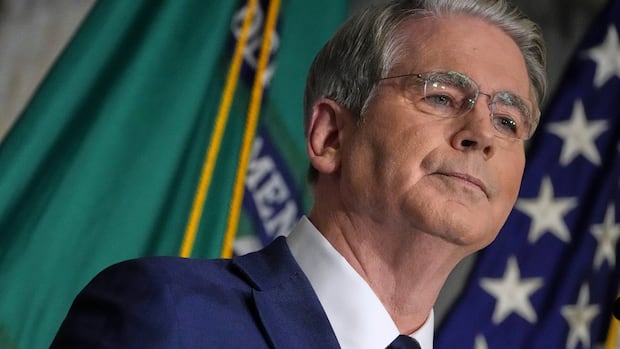
During a press briefing, Treasury Secretary Scott Bessent introduced what he termed an “economic D-Day,” which serves as a final alert for countries to sever their business connections with Iran or face the risk of key firms being excluded from the dollar-based financial system.
“We are initiating an economic assault on Iran’s financial networks worldwide. Our goal is to cut off every economic support line that upholds this oppressive regime until Tehran is isolated,” Bessent stated.
The U.S. Treasury Department indicated that it has mapped out the networks, facilitators, and financial routes Iran utilizes to smuggle oil and circumvent sanctions, asserting that Washington will collaborate with U.S. allies to target any source of Iran’s “illicit revenue.”
The department announced determinations against five sectors—digital assets, technology, gold, aviation, and shipping—that the Iranian government relies on to support its economy. Additionally, nearly 60 entities, individuals, and vessels have been sanctioned.
For several years, China has been the largest purchaser of Iranian oil. Washington has stepped up efforts to restrict Chinese purchases but has yet to target larger Chinese banks that may be facilitating this trade.

Iran is offering a $30,000 US bounty to any Iranian who can capture or kill American soldiers. Andrew Chang breaks down why the timing of the announcement matters, its propaganda value, and how realistic it actually is.
(Photo credits: The Canadian Press, Reuters, Adobe Stock and Getty Images)
‘Wait for an attack,’ Iran warns
Prior to the announcement, Iran issued threats of a potential military retaliation and a further decrease in oil exports from the Gulf in response to any U.S. economic actions.
Following the announcement, Iranian Finance and Economic Affairs Minister Ali Madanizadeh stated, “We are fully prepared for the U.S. sanctions.”
“Naturally, our adversaries intend to launch an economic terrorist offensive against us, but we have our own resources and know how to navigate this situation. Our defense is now more proactive; the enemies should anticipate a counterattack,” Madanizadeh told state television.
Brig-Gen. Hossein Mohebbi, spokesperson for Iran’s Islamic Revolutionary Guard Corps (IRGC), promised severe repercussions to U.S. interests and energy chokepoints if Iran’s infrastructure is jeopardized, according to Press TV.
The conflict between the U.S. and Iran is approaching the six-month mark, contributing to rising energy prices globally. Although intense fighting has diminished, diplomatic attempts to resolve the situation have stalled, and oil and raw material shipments through the Strait of Hormuz remain obstructed, keeping energy prices high.
Trump’s approval rating has dipped to a low, with only 33 percent of Americans in the latest Reuters/Ipsos poll expressing approval of his performance. He argues that the economic consequences are essential to prevent Iran from acquiring a nuclear weapon.
The U.S. has upheld sanctions against Iran for many years. Most of these sanctions have focused on limiting the nation’s oil income, targeting its aviation sector and cryptocurrency activities, restricting its acquisition of weapon components and military hardware, and cutting off funding to businesses controlled by the IRGC, a significant influence in the Iranian economy.
The sanctions prevent designated entities from accessing the dollar-based financial system, yet Iran has efficiently established new front companies, entities, and vessel registrations to evade these restrictions.

