
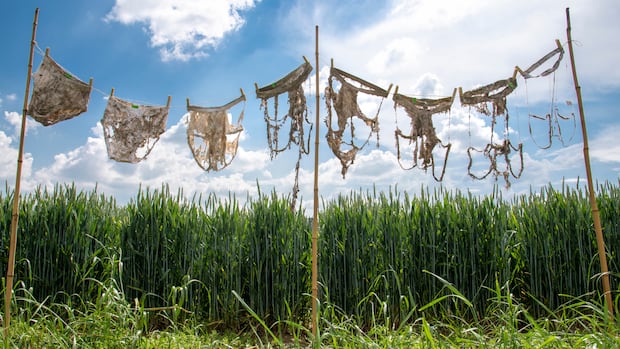

Franz Bender managed to persuade a thousand individuals to bury their underwear — and it had nothing to do with bowel issues.
In 2021, the Swiss soil ecologist along with his team enlisted 1,000 citizen scientists to bury and retrieve underwear across Switzerland to enhance their understanding of soil health. In September, the research received an Ig Nobel Prize, an award presented yearly for research that amuses and provokes thought.
The initiative produced some unexpected findings for both the researchers and participants when they dug up their underwear, which the ravenous underground microbes frequently reduced to nearly nothing.
“I think the moment when people excavate the underwear and examine it was truly eye-opening for many,” Bender, who is affiliated with the Agroscope agricultural research center in Zurich, shared with Quirks & Quarks host Bob McDonald.
“It’s intriguing to realize that soil is indeed alive, and there exists a vast amount of life below the surface that we typically overlook.”
The research was published in Plants People Planet in August 2026.
However, Bender isn’t the pioneer in burying underwear. The practice actually has Canadian origins.
The Innovative Farmers Association of Ontario began placing underwear in fields in Ontario around 2015, according to farmer Alan Kruszel. While individuals had been burying cotton strips known as assays for many years, farmers opted for underwear for a more entertaining approach.
It was so enjoyable, in fact, that Kruszel proposed expanding it nationally. Thus, in 2017, the national “Soil Your Undies” initiative was launched.
“It was an absolute success,” Kruszel, a board member with the Soil Conservation Council of Canada, remarked to Quirks & Quarks.
“The aim was to encourage individuals to regard soil as a living, breathing ecosystem and to heighten awareness regarding its significance and health.”
-
Okanagan grape growers say crop insurance model failing amid wildfire smoke taint
-
This is how fast Swiss glaciers, the ‘water tower of Europe,’ are melting away
And it wasn’t just farmers and soil scientists eager to place what typically resides beneath our clothing into the ground beneath us.
“I buried underwear with all sorts of different groups. We did it with senators, university deans, school children, even the Canadian Ag Museum in Ottawa joined in,” Kruszel shared.
“Garden clubs … you wouldn’t believe how much joy a group of older women had while holding up soiled underwear.”
A colleague of Bender recognized the potential and proposed a similar initiative in Switzerland. They organized a small event where families could bury underwear in the soil.
“The Swiss media was thrilled. It received extensive coverage,” Bender noted. “Then another collaborator approached us and suggested, ‘Hey, why don’t we launch a citizen science project out of this and make it something grand?’”
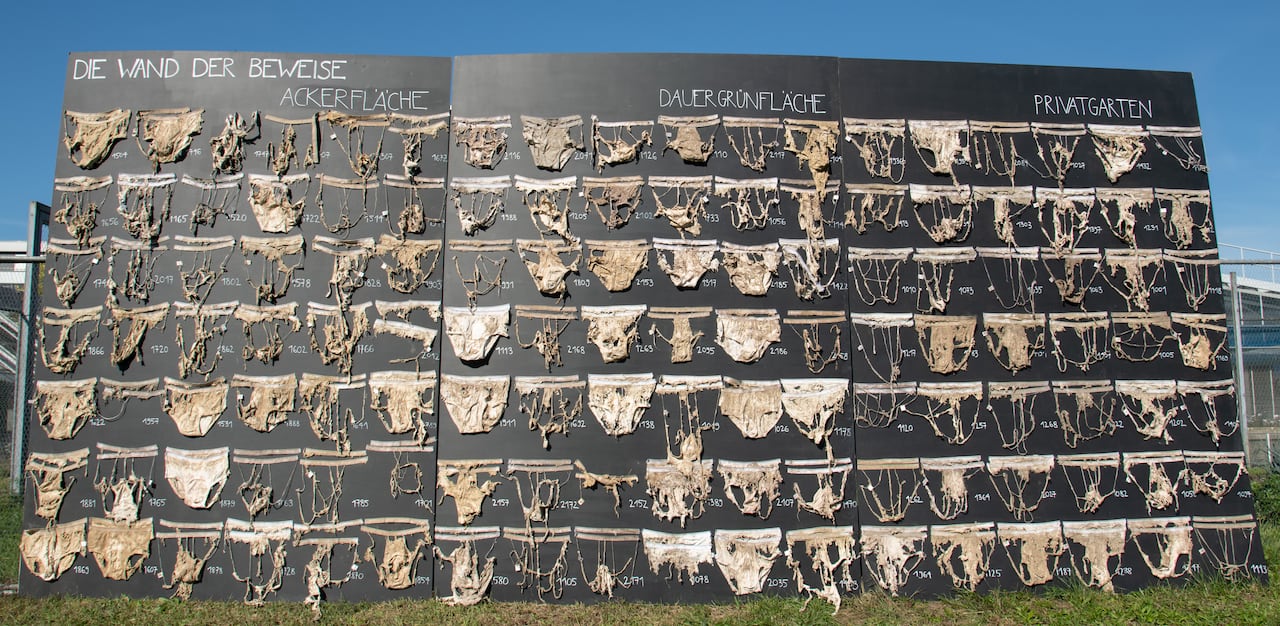
Results of underwear buried in soil in arable land, lawns, and gardens on display in Switzerland. Soil ecologist Franz Bender stated that the study revealed the highest decomposition in gardens and the least in lawns, with arable fields and grasslands in between. (Prisca Koller/Agroscope)
Bender and his research group sought 1,000 citizen scientists, but they received about 1,400 applications, necessitating a selection process to ensure geographic diversity across Switzerland. Bender and his team dispatched two pairs of size small organic cotton underwear, 12 teabags for comparison, along with comprehensive instructions to the volunteers.
“We provided clear diagrams on how to place them in the soil, at what depth, and where the teabags should go,” Bender explained.
The team also designed a smartphone application that allowed participants to input additional information, such as photos and geographic details, and to respond to questions regarding the land, such as whether it was fertilized or treated with pesticides.
The citizen scientists excavated one pair of underwear and one set of teabags after four weeks, and the second pair of underwear along with the remaining teabags after eight weeks.
Soil consumes underwear
While underwear may not seem like a tempting meal, it proved to be quite a treat for the microbes and other life in rich, biologically active soil. However, when retrieved from different types of soil, the unearthed underwear often appeared barely worn.
“In some cases, only the synthetic threads around the waistband remained. The underwear was entirely consumed,” Bender remarked. “In other instances, the underwear looked nearly new.”
Overall, the underwear experienced the most decomposition in private gardens and flowerbeds, while lawns showed the least decomposition. Arable fields and grasslands fell somewhere in between.
Bender noted that gardens typically contain a lot of compost and often benefit from irrigation, fostering soil conditions rich in nutrients, organic matter, and moisture. This enhances soil biological activity, which leads to the degradation of underwear.
Conversely, lawns lack significant species diversity above ground and are frequently mowed. As a result, the soil ecosystem beneath lawns is not nearly as vibrant and active as that in gardens, leading to some buried underwear appearing more soiled than consumed.
-
Here’s why southern Ontario farmers are supporting a new bill to make soil a national asset
-
Audio
Sask. soil has improved by about 40% over the last 3 decades, study finds
There were some surprising outcomes, however. Bender expressed astonishment at the high nutrient levels found in private gardens, as well as the minimal decomposition of underwear in agricultural soil compared to his expectations.
Bender also warns that more active, fertile soil does not necessarily equate to “healthier” soil. For instance, it can negatively impact biodiversity in forests or natural reserves.
Bender hopes that this research will help people appreciate the crucial role of soil, especially as human actions like chemical usage impact it in unpredictable ways.
“Soil is vital for sustaining the cycle of life, and we all rely on it,” he emphasized. “Without adequate knowledge about soil, it becomes challenging to protect it.”
Underwear sparks interest in soil: experts
Asim Biswas, a professor and Canada Research Chair in digital agriculture at the University of Guelph, mentioned that while the study is scientifically valid, its most significant contribution lies in the awareness it has raised regarding soil.
“It garnered significant media attention across 25 countries — that’s remarkable,” he commented.
“I believe this was an effective advocacy tool for soil because it’s humorous, and people tend to remember such things.”
Biswas supports Bender’s caution that more active, fertile soil isn’t always healthier, adding that there remains much research to be conducted in this area.
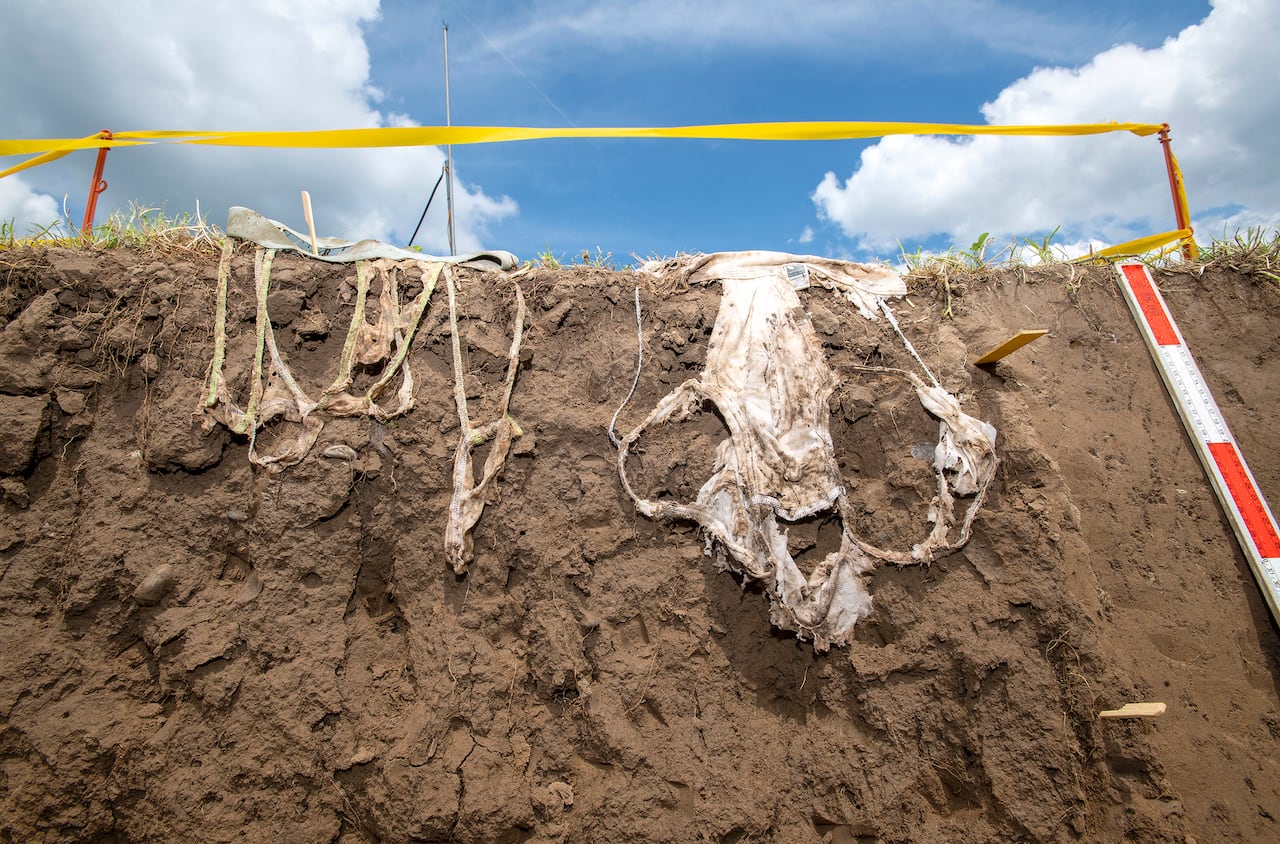
Soil scientists assert that the practice of burying and retrieving underwear can serve as an effective means to assess soil’s biological activity, while also engaging public interest in the subject. (Gabriela Braendle/Agroscope)
Joann Whalen, a soil scientist at McGill University, noted that the underwear method is an easier, quicker, and more cost-effective alternative to chemical laboratory assessments.
“We might encounter scenarios where someone is curious about their soil but hasn’t had the chance or resources to test it,” she explained.
“With a visual test like this, seeing the degradation of the underwear gives a fairly rapid insight into the condition of the soil.”
The Soil Conservation Council of Canada endorses this approach, and offers guidance.
Additionally, the unearthed Swiss underwear will be repurposed. Bender and his team have teamed up with a fashion designer who has already created a dress from some of the items.
“More fashion items will emerge from this,” Bender stated.

