
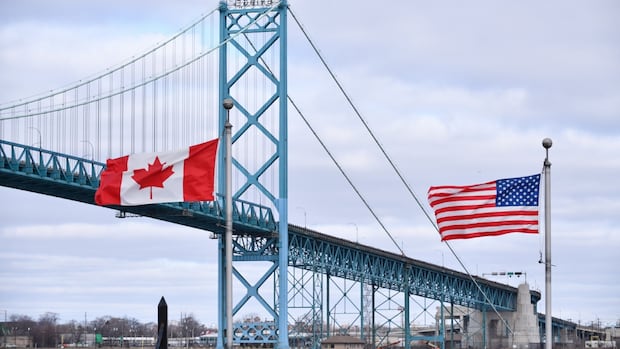
According to data from both Canada and the United States, cocaine is the most commonly seized drug in southwestern Ontario at the Canada-U.S. border.
During the first half of this year, the Canada Border Services Agency (CBSA) confiscated over 827,000 grams of cocaine, valued at more than $82 million, at several border crossings including the Ambassador Bridge, Detroit-Windsor Tunnel, Blue Water Bridge, Peace Bridge, Queenston Bridge, Rainbow Bridge, and Walpole Island.
In the previous year, the CBSA captured 1,631,981 grams of cocaine, and in 2024, the amount seized was 1,515,369 grams, with each year representing a value exceeding $150 million.
Justin Morgan, chief of operations with the CBSA at the Ambassador Bridge, stated, “The majority of our operations involve narcotics coming from the United States.”

Justin Morgan is chief of operations with the Canada Border Services Agency (CBSA) at the Ambassador Bridge. (Ken Amlin/CBC News)
Cocaine was similarly the drug most often seized by officials from U.S. Customs and Border Protection (CBP) at these same border points, as per CBP data.
In 2024, they confiscated 927,142 grams and 2,092,875 grams in 2025.
A watch commander from Customs and Border Protection informed CBC that much of the cocaine intercepted in Detroit is destined for Canada and originates from the U.S., rather than from Canada itself.
“It’s really not a significant issue for inbound traffic,” stated Lavarah Miller. “Most of what we seize is actually going outbound.”
This year, marijuana seizures by the CBP (1,797,133 grams) have significantly surpassed cocaine seizures (242,218 grams) for the period spanning from October 1, 2025, to July 6, 2026.

Cocaine is attractive to criminal organizations due to its stable supply and established distribution networks, according to a researcher.
According to Benoît Gomis, a lecturer at the Munk School of Global Affairs and Public Policy in Toronto, data on drug seizures does not provide a complete overview of the situation.
He remarked, “Ultimately, we really don’t know” what crosses the border without detection.
Furthermore, trends in drug seizures lack context, which could indicate various scenarios, as Gomis explained.
“It could suggest that law enforcement had luck with larger seizures,” he noted.
“It might indicate increased political will to target that specific substance or even an uptick in the volume of drugs available.”
What makes cocaine attractive to criminal organizations?
Gomis pointed out that there is a “very stable source” for the plant used to produce cocaine, primarily located in Colombia and Peru.
This reliability is one of the factors that render the drug appealing to criminal networks, he noted.
“Cocaine has been a constant; there is a very clear playbook they are familiar with. It’s a simple substance to smuggle [due to its small size],” Gomis explained.
“There is a consistent demand, and the distribution networks are well-established.”
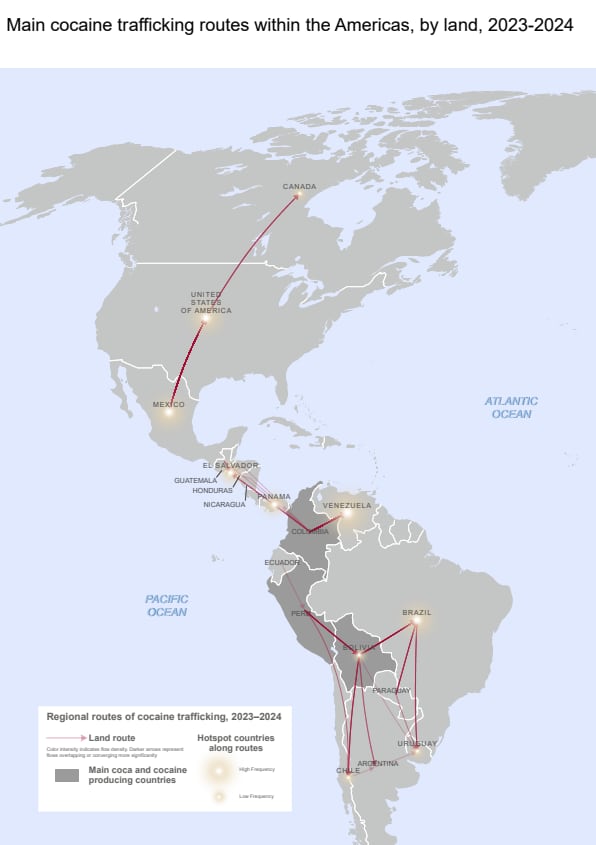
An image from the United Nations Office on Drugs and Crime shows the main, land-based cocaine trafficking routes within the Americas in 2023-24. (United Nations)
Research conducted by Gomis suggests that cocaine consumption is on the rise, estimating that between two to three percent of the adult population has used the drug within the past year.
“We have also gathered anecdotal evidence indicating that the purity is increasing as well, particularly in the U.S., Canada, and Western Europe, which is leading to various harms,” Gomis stated.
“The toxicity and potential lethality of the drug have been on the rise. Additionally, it is often mixed with other drugs, including fentanyl and various other substances.”
The United Nations Office on Drugs and Crime publishes information on global drug trafficking, labeling it a “clear threat” on a worldwide scale.
It emphasizes the damage cocaine has inflicted in Canada, citing a 2018 statistic that indicated it was the most reported drug among individuals entering treatment programs in the country.
Recent data from 2020-23 indicates that cocaine trafficking operations originate in the Andean regions of South America and travel north through Mexico into the U.S. and subsequently into Canada.
How does Canada identify drugs at the U.S. border?
The CBSA granted CBC News unique access to the Ambassador Bridge port of entry to demonstrate its drug detection methods at the border.
In certain instances, it utilizes its own intelligence or information from other law enforcement bodies to identify suspicious incoming shipments for automatic inspection.
“This enables our officers to recognize different trends and concealment techniques employed by transnational organized crime groups,” Morgan explained.
“Anything you can think of, transnational organized crime groups have already considered and implemented,” he added.
Morgan mentioned that CBSA officers are also trained to detect verbal or non-verbal signals, issues with commercial documentation, and other suspicious indicators.
The CBSA employs various tools to aid its officers, such as detector dogs, large-scale imaging units, a mobile X-ray truck, and handheld devices capable of detecting items like firearms inside vehicles prior to conducting a thorough search.
Canada’s new border crossing features advanced detection technology
The recently opened Gordie Howe International Bridge, which became operational on July 27, boasts 24 inspection lanes, the highest number at any Canadian port of entry.
This new crossing also facilitates more thorough inspections of commercial trucks due to on-site X-ray technology; officials state that trailers no longer need to be offloaded, which can be a lengthy process.
The Gordie Howe bridge has examination bays that are not available at the Ambassador Bridge, along with smaller-scale X-ray capabilities on the inside.
“We also possess a specialized facility within this commercial examination zone where we can safely analyze packages containing potentially highly toxic substances, such as fentanyl or methamphetamine,” said Sydney Kale, CBSA’s district director for the Gordie Howe International Bridge.

