

President Donald Trump of the United States has indicated he may implement a ban on diesel exports to enhance gasoline prices for Americans, a strategy experts warn could exacerbate an already pressured global market—driving diesel prices higher in Canada and other nations.
During a discussion with Ukrainian President Volodymyr Zelenskyy at a UN General Assembly meeting on Tuesday, Trump announced his intentions regarding a diesel export ban.
“I’ve suggested, ‘Let’s refrain from sending out the diesel.’ We produce a substantial amount of diesel. This might slightly influence standard automotive gasoline,” Trump stated, as Republican colleagues face mounting pressure regarding gas prices ahead of the upcoming midterm elections in November.
Scott Bessent, the U.S. Treasury Secretary present at the meeting, noted that Washington is assessing “the feasibility of this… and whether a complete or partial ban would be effective.”
However, a White House representative denied a report from Politico on Thursday that the U.S. is actively preparing a 90-day ban on diesel exports, and U.S. Energy Secretary Chris Wright confirmed that a total ban is not under consideration.
This proposal arises amidst unprecedented diesel prices, which have surged due to the ongoing conflicts in Iran and Ukraine. Diesel prices in Canada have exceeded $2 per litre for the past 12 weeks, reaching $2.66 a litre on Thursday, over a dollar higher than the same period last year.
In the United States, diesel prices have surpassed $6.50 per gallon, as reported by the American Automobile Association, while last year at this time, the average was $3.69.
Experts concur that a U.S. ban on diesel exports would further destabilize the global market.
“This appears to be a rather ill-conceived policy idea that overlooks the actual challenges we face presently,” stated Joe Calnan, vice-president of energy at the Canadian Global Affairs Institute, in an interview with CBC News.
According to Calnan, the U.S. exports roughly 1.5 million barrels of diesel each day, mainly to Latin America and Western Europe. Removing this supply from the market would likely result in a price increase across the board.
A report from Wood Mackenzie, a UK-based analytics firm, highlighted that Europe would be especially susceptible to the effects, as its share of U.S. diesel exports has risen to 50 percent in September, compared to an average of 30 percent in 2025.
Potential Impact on Canada
A global price increase would also affect Canada, worsening current issues, according to Calnan.
Diesel fuels the trucks that transport food and goods nationwide, as well as the tractors used in food harvesting.

The cost of diesel continues to rise, placing a significant burden on farmers in the region, particularly during the fall harvest. CBC’s Connor Lamont provides insight.
As farmers engage in harvest season, the current price disparity is already noticeable. An Ontario farmer mentioned earlier this month that the price to refuel his combine has increased by $1,000 per fill-up.
Calnan also points out that diesel is critical for power generation in remote areas of Canada and for home heating in the Maritimes, indicating that a potential rise in diesel prices could have broader consequences in those regions.
“Consumers will see impacts at the pump for diesel, and for those specific users,” Calnan stated.
Nonetheless, experts argue that a U.S. export ban would not result in a diesel shortage in Canada, as the nation produces significantly more diesel than it imports. In 2024, Canada exported 10.8 billion litres.
“Canada exports nearly double what it imports, so the country could manage without U.S. exports quite comfortably,” said Carol Montreuil, vice president at the Canadian Fuels Association.
“However, the pricing scenario would be quite different.”
Record-High Prices
The ongoing conflict with Iran is one of the key contributors to the surge in diesel prices. Prior to the U.S., in conjunction with Israel, commencing hostilities in February, the Strait of Hormuz facilitated approximately 125 commercial vessels daily, which accounted for around 20 percent of the global crude oil and liquefied natural gas supply.
Recently, ships have begun to navigate through the strait again after months of restrictions, but the flow remains minimal, with merely 10 vessels passing through on Wednesday, as per shipping data.

Vessels near the Strait of Hormuz, as captured from Musandam, Oman, on August 31. While there is a slight movement of ships through the strait now, oil shipping is far from its normal capacity. (Stringer/File Photo/Reuters)
Additionally, tension between the Iranian-backed Houthis and Yemen’s Saudi-supported government forces near the Bab el-Mandeb Strait, another critical supply route, is intensifying supply pressures.
In parallel, Russia, a major diesel exporter, has repeatedly extended its ban on diesel exports due to its ongoing conflict in Ukraine.
These conflicts have resulted in an estimated seven million barrels per day of refining capacity being taken offline, according to Montreuil.
“When considering that the global market operates on about 100 million barrels a day, the loss of seven million barrels per day, or roughly seven percent of refining capacity, is substantial, and this effect is being reflected in prices.”
-
Photos
Sky-high crude and diesel prices are fuelling protests worldwide
-
The price of diesel is skyrocketing. Here’s why Canadians may soon feel it at the grocery store
While retaining all diesel within the U.S. might provide a temporary boost to gas prices for Americans, experts assert that it would ultimately lead to increased costs.
Patrick De Haan, head of petroleum analysis at Gas Buddy, suggests that diesel prices in the U.S. might initially decrease.
However, U.S. refineries would need to reduce production to prevent a diesel surplus once exports cease. With more diesel being redirected to storage, refineries would likely scale back crude oil processing to avoid exceeding storage capacity, which would eventually affect regular gasoline prices.
“This would send a troubling message to U.S. refineries that the government intends to control their supply decisions,” he indicated.
-
Farmers hit hard by high diesel prices — and unsure what the future holds
-
‘Very scary’: Nova Scotians feeling the pinch of rising home heating costs
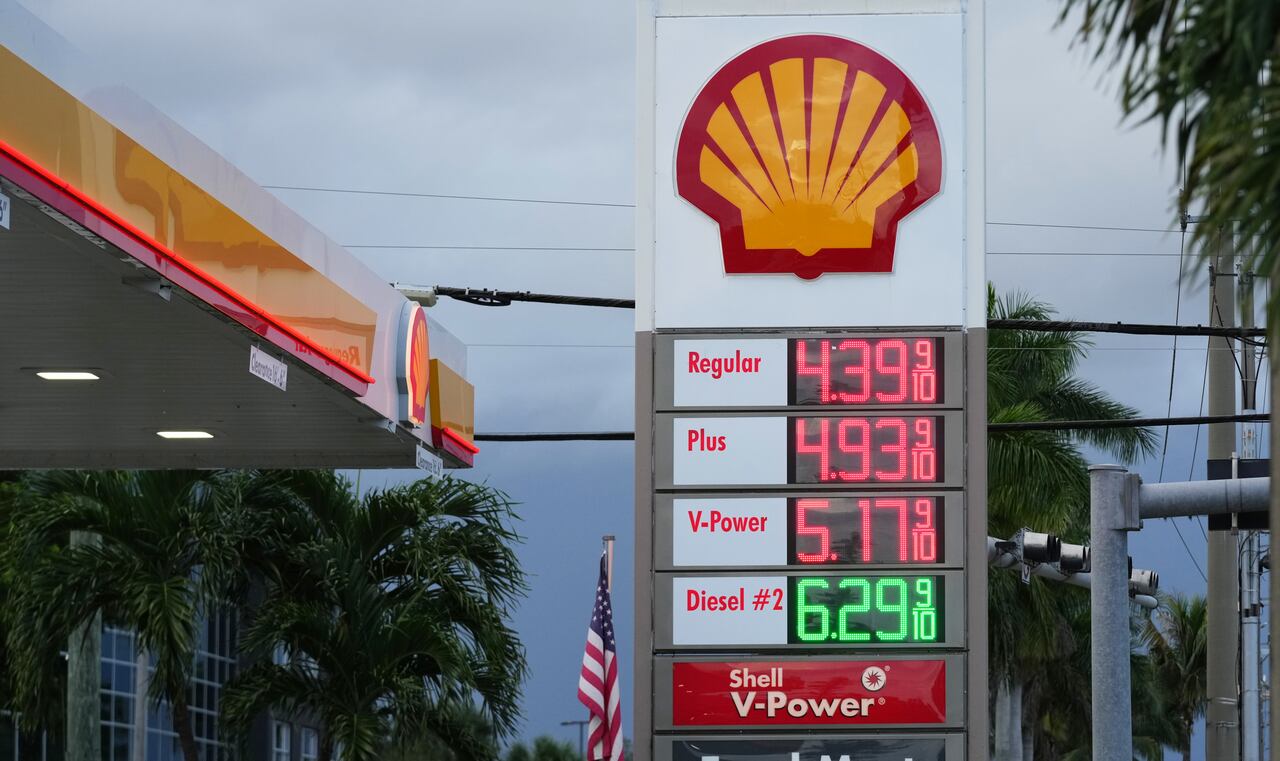
Gas and diesel prices are displayed at a Shell station on Tuesday, in Doral, Fla. (Lynne Sladky/The Associated Press)

