

The White House released a statement on Tuesday outlining “facts” regarding Canada’s exploitation of its trade relationship with the United States “for decades.”
This statement marks another escalation in the ongoing trade conflict between the two nations. Negotiations regarding tariffs broke down on Friday night when Prime Minister Mark Carney withdrew, stating that the U.S. “demanded too much and offered too little.”
Some assertions made by the White House about Canada are accurate, while others reflect opinions held by U.S. President Donald Trump or are arguments that remain subject to dispute. Here’s an overview of the White House’s remarks.
-
Federal ministers announce support for Canadians, counter-tariffs against U.S.
-
Q&A
Canada ‘can’t afford’ to wait for Trump to be reasonable, says jobs minister
Are we alone with China in retaliating against U.S. tariffs?
The initial claim in the White House statement asserts: “Canada is only joined by the People’s Republic of China in opting for retaliation instead of negotiation.”
While Canada has engaged in discussions with the U.S. over the past month, this assertion seems to hold some truth. Numerous trading partners have indicated they might retaliate against Trump’s tariffs but have not yet taken action.
- With the trade war intensifying, are you considering buying Canadian products again? We would like to hear your thoughts—email us at ask@cbc.ca.
Mexico is currently negotiating to lower similar tariffs that Canada faces on steel, aluminum, and vehicles, but has not threatened specific counteractions.
Brazil is threatening to respond to U.S. tariffs. Both the United Kingdom and the European Union contemplated counter-tariffs following “Liberation Day” in 2025 but ultimately opted to refrain from implementing them.
Canada imposes tariffs on vehicles imported from the U.S.
The statement charges Canada with implementing a “discriminatory” 25 percent tariff on vehicle imports from the U.S., labeling it as unjust because it states the measures were “not applied to any other nation.”
This assertion is technically accurate; however, the reason Canada enacted the tariff on April 9, 2025, was in response to a similar action taken by the U.S. just days prior. This tariff only affects non-CUSMA-compliant vehicles coming from the U.S., mirroring the U.S. action against Canada.
The negotiations that unraveled on Friday were partly focused on either eliminating or at least mitigating this tariff.
Has Canada banned most U.S. alcohol from shelves?
One of the most notable actions taken by Canadian provinces following the implementation of new tariffs by Trump in 2025 was the removal of U.S. alcohol from the shelves of government-operated liquor stores.
The White House statement asserts: “Canada has prohibited American wine, beer, and spirits in nearly every province and territory—while other nations have not faced such restrictions. Consequently, U.S. alcohol exports to Canada plummeted by 81% in just one year.”

Bottles of Canadian liquor are displayed at a B.C. Liquor store in Vancouver on Tuesday. (Ben Nelms/CBC)
It is accurate that all provinces, with the exception of Saskatchewan and Alberta, have enacted this measure. Recent statements from premiers indicate they would only lift the bans if Trump’s tariffs are significantly reduced or eliminated. Following the breakdown of trade discussions, they assert that U.S. alcohol will not be returning to shelves anytime soon.
In recent months, politicians from California have urged Canada to remove the ban, claiming it has adversely affected wineries in their state. Meanwhile, in Kentucky, Gov. Andy Beshear acknowledged last week that the bourbon industry is suffering, as Canada is the top trading partner for his state.
Does Canada impose a 300% tariff on U.S. dairy?
Trump has consistently criticized Canada’s dairy sector, and the White House reiterated this point.
The statement claims: “Canada restricts U.S. dairy with tariff-rate quotas that are significantly more stringent than those granted to Europe, along with over-quota tariffs nearing 300%—rates so extreme they act as a near-total prohibition and rank among the highest agricultural tariffs in the developed world.”
However, Canada has not excluded U.S. dairy from its market. The regulations are intricate, but U.S. dairy exporters can ship their products to Canada without tariffs, within a specified limit—which they have yet to reach. Beyond that limit, tariffs can be as high as 250 percent, but this scenario has never materialized.
What particularly frustrates the U.S. is that its retailers are prohibited from selling dairy products directly in Canada. This restriction explains why American milk is not available in grocery stores there.
Conversely, Canada’s agreement with the EU permits certain retail brands from Europe to sell their goods in Canada, especially cheese, a situation the U.S. deems unfair.
It is also worth mentioning that the existing tariff regulations regarding U.S. dairy entering Canada were negotiated and accepted by Trump during his first term.
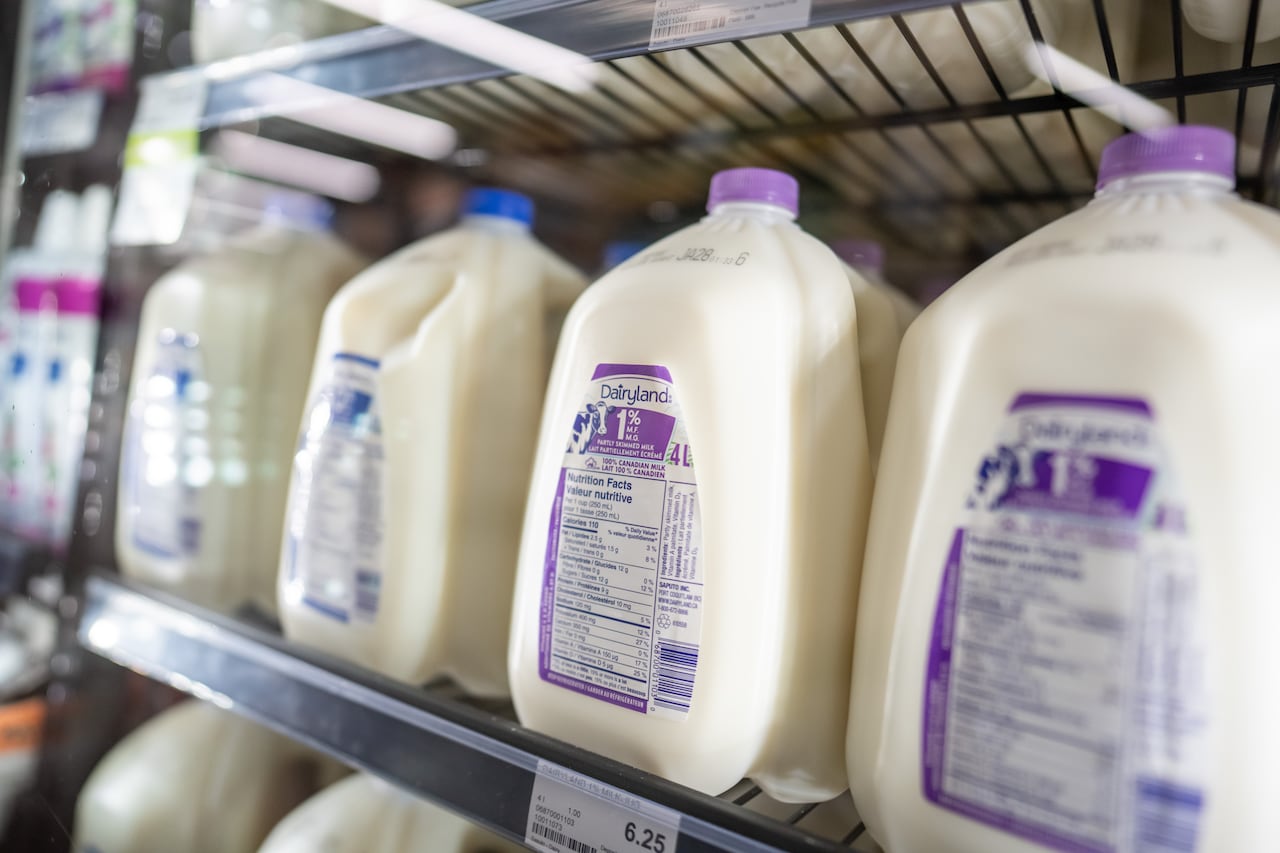
American retailers are prohibited from selling dairy directly in Canada. Hence, U.S. milk cannot be found in grocery stores there. (Ben Nelms/CBC)
The U.S. trade deficit with Canada
Trump often emphasizes trade deficits, interpreting them as an indicator of weakness.
The White House states, “Canada has extracted a persistent average annual goods trade deficit of about $50 billion from the U.S. over the past decade—while refusing reciprocal access.”
The overall figure is accurate (it was $48.5 billion in 2025, according to the U.S. Trade Representative). However, as noted by premiers and others, the primary reason for this is that Canada exported 3.9 million barrels of oil daily to the U.S. last year.
States near the Canadian border depend on this oil, which is sold at below-market rates, providing a significant economic benefit to the U.S.
If the oil were excluded from the calculations, the U.S. would actually have a goods surplus with Canada. In other words, when excluding energy, the U.S. exports more goods to Canada than Canada does to the U.S.

Finance Minister François-Philippe Champagne states that Canada will respond to the latest round of U.S. tariffs in a ‘proportionate, targeted and strategic’ manner. Champagne emphasizes that the tariffs, affecting over $27 billion in U.S. goods, focus on fairness.
Some White House assertions lack verifiability
The statement comprises several “facts” that are essentially opinions or claims that remain debatable.
For instance, it asserts: “Without the United States, Canada could not survive. Canada sends approximately three-quarters of all its goods exports to America.” While this figure is accurate and no Canadian officials dispute the significance of the U.S. market, the notion of Canada’s survival without the U.S. is a hypothetical scenario that is not seriously considered.
The statement further claims: “Canada’s ineffective trade policies are driving its own manufacturers to relocate south. A recent survey found that 42% of Canadian manufacturers have already moved or are planning to move production to the U.S.”
The KPMG survey indicates that companies are relocating or considering relocation “due to economic uncertainty and trade and tariff threats,” rather than “Canada’s ineffective trade policies.”
The White House statement concludes with a claim that the U.S. “has the clear leverage” since its economy is significantly larger. While no one disputes the size advantage, the discussion regarding who possesses the upper hand in this trade conflict remains unresolved.
- Do you support Canada’s new retaliatory tariffs on the U.S., set for Sept. 8? Click “Join the Conversation” below. On the app? Tap here.

