
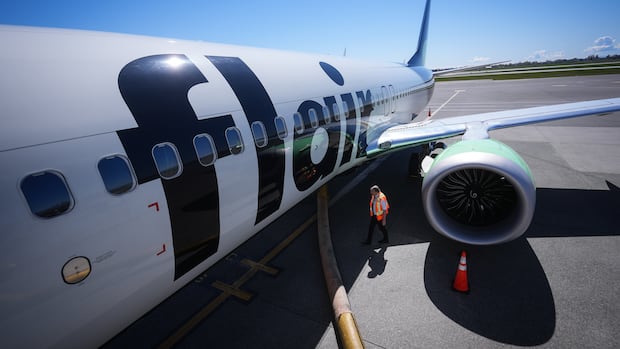
Flair Airlines’ CEO Len Corrado is grappling with the challenges posed by soaring jet fuel prices as he shifts the airline’s strategy away from focusing on business travelers and U.S. destinations. In a phone conversation, Corrado, who took over the leadership role in February, noted that aviation fuel constitutes nearly one-third of Flair’s operational costs. The International Air Transport Association reported that fuel prices in North America have surged by over 110 percent compared to last year.
“Navigating this situation is difficult and challenging,” remarked the seasoned industry professional. The increase in ticket prices has not entirely compensated for the escalating costs.
“While fares have risen somewhat overall, they haven’t fully covered the increased costs. It’s a daily battle,” he added.
Earlier this month, the federal government granted Flair $76 million in emergency funding, highlighting that it is not the only airline seeking assistance amid soaring fuel prices.
In the past two months, both Porter Airlines and Air Transat’s parent company, Transat A.T. Inc., have also obtained bailouts from the government as rising jet fuel prices continue to impact airline finances.
Transat has accessed $430 million in low-interest loans since the onset of the Iran conflict in late February, which has led to a spike in energy prices, largely due to disruptions in the Strait of Hormuz, a major oil transit route.
According to the Canada Enterprise Emergency Funding Corp., Porter received a loan of $125 million.
These loans are required to be repaid within a four-year timeframe.
High demand for cross-Canada tourism, CEO states
In response to changing demand patterns, Flair is increasing its domestic and Caribbean operations while reducing its Canada-U.S. flight offerings by over 50 percent since last year, as Canadian travelers show reluctance towards U.S. travel.
“There’s a significant demand for tourism within Canada,” Corrado noted, highlighting Flair’s efforts to penetrate the Quebec market.
In August 2025, Flair operated no flights from Montreal’s Trudeau Airport; however, last month, that number rose to 62, as reported by aviation data tracker Cirium.
“For a long time, we didn’t engage with Montreal or Quebec — about 9.6 million potential customers we overlooked,” he mentioned. “Canadians have clearly expressed their reluctance to travel to the U.S.”
The Edmonton-based low-cost airline is refocusing on personal travel, moving away from its earlier strategy to target small business travelers, Corrado stated.
“Ninety-five percent, if not more, of our passengers book their travel using personal credit cards instead of corporate accounts,” he explained. “We are not positioned as a business travel airline.”
The majority of Flair’s clientele is driven by an “emotional demand” for vacations or family visits, he added.
“They are attending events like Auntie Mary’s funeral or Cousin Bobby’s wedding. Those are the connections that matter to them. That’s our primary focus,” he stated.
Cirium’s data shows that around 85 percent of Flair’s flights next month will be domestic, although that figure drops to just over 50 percent in the winter as travelers seek out sunny destinations.
To attract these passengers, Flair has engaged with one of the few global distribution systems that serve as the digital backbone of commercial aviation.
Systems like Amadeus and Sabre link travel agents and online booking platforms with airlines, hotels, and car rental services, creating a centralized marketplace that simplifies bookings from various providers into a single transaction.
This month, Flair announced a partnership with Montreal-based Softvoyage to capture business from travelers who choose to book through travel agencies or tour operators.
The outcome of this strategy and whether it will lead Flair to achieve annual profitability remains uncertain, as the CEO refrained from disclosing whether the airline has reached that milestone, citing its private ownership.
“I returned from retirement because I saw something special in this opportunity. I perceive it as a small engine that could,” he concluded.
MORE TOP STORIES

