
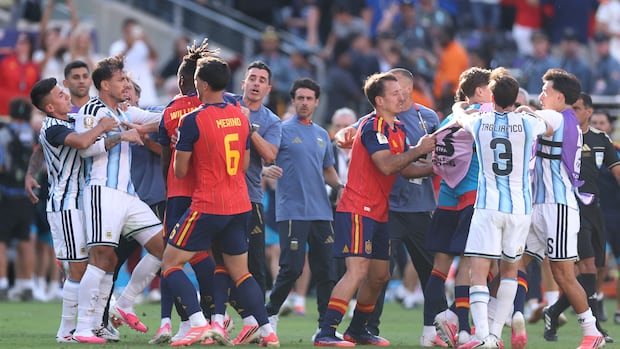
On Friday, FIFA issued bans to three players from Argentina, with midfielder Leandro Paredes receiving a hefty 10-match suspension for physically confronting Spanish players following their defeat in the World Cup final.
Paredes’ penalty — which involved him choking Spain’s Eric Garcia and pushing Gavi to the ground — is considered one of the most severe penalties in World Cup history, comparable to the sanctions given to Uruguayan forward Luis Suarez in 2014.
Defender Nahuel Molina was imposed a seven-match ban, while Thiago Almada received a one-match suspension. FIFA also levied fines of $90,000 US against both Paredes and Molina, while Almada was fined $30,000.
Paredes’ suspension effectively sidelines him from the Argentina national team for a year, as the FIFA schedule includes 10 matches through June 2027.
It is possible that all these matches will be friendlies, as no competitive events are currently arranged.
Gavi banned for match against England
Gavi has also been suspended for one match, specifically a Nations League game for Spain against England at Wembley, scheduled for September 26.
Roberto Ayala, a coach for Argentina, received a three-match ban along with a $30,000 fine.
The Argentine Football Association was fined a total of $110,000 for various incidents during the World Cup, which included players displaying a political banner regarding the Falkland Islands after their semifinal victory over England, as well as fans engaging in discriminatory chants.
Additionally, FIFA mandated that the AFA allocate $100,000 towards anti-racism initiatives. Argentina was awarded $34 million in prize money from FIFA following the World Cup.
Argentina likely to file an appeal
The AFA has the option to appeal the extensive sanctions and fines to FIFA, and is expected to follow up with an appeal to the Court of Arbitration for Sport if necessary.
In an official statement, the federation noted, “The AFA legal department will timely request the grounds for the reviewable rulings from FIFA to initiate appeals with the governing body’s appeal committee, while keeping the option to appeal to the CAS as a final recourse.”
Cases of Suarez and Simunic
In 2014, Suarez faced a four-month ban from all soccer activities, including with his new club Barcelona, along with an additional eight-match suspension for Uruguay after biting Italian defender Giorgio Chiellini during a World Cup group stage match in Brazil.
Paredes’ 10-game suspension matches the penalty given to Croatia’s Josip Simunic in 2013 after a World Cup qualifying playoff, where Simunic used a megaphone to lead fans in chants associated with the country’s pro-Nazi regime during World War II.
The on-field altercations during last month’s final in East Rutherford, New Jersey — classified by FIFA as assault incidents — occurred after Argentina lost a contentious match to Spain, where they struggled to compete and created very few scoring opportunities.
Spain’s Ferran Torres netted the sole goal during the second half of extra time, following the red card issued to Argentina’s Enzo Fernandez.
FIFA’s disciplinary judges also mandated that Argentina host its next home match in a stadium with a capacity limited to 50%. A second stadium sanction and a $100,000 penalty were deferred for probationary periods.

