
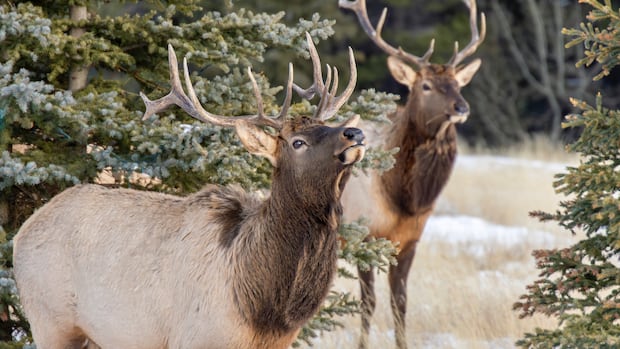
Amidst the vibrant orange foliage of larches, a sharp call reverberates throughout the Bow Valley.
As the autumn rut begins, male ungulates throughout North America are vying for mating privileges.
This includes elk, which are frequently spotted across large parts of Alberta. At this time of year, it’s common to both see and hear bull elk attempting to establish their dominance in the Canadian Rockies.
While that distinctive bugle call may sound equally eerie to human listeners across the continent, research conducted in the United States indicates that elk in various regions may actually be using different dialects to communicate.
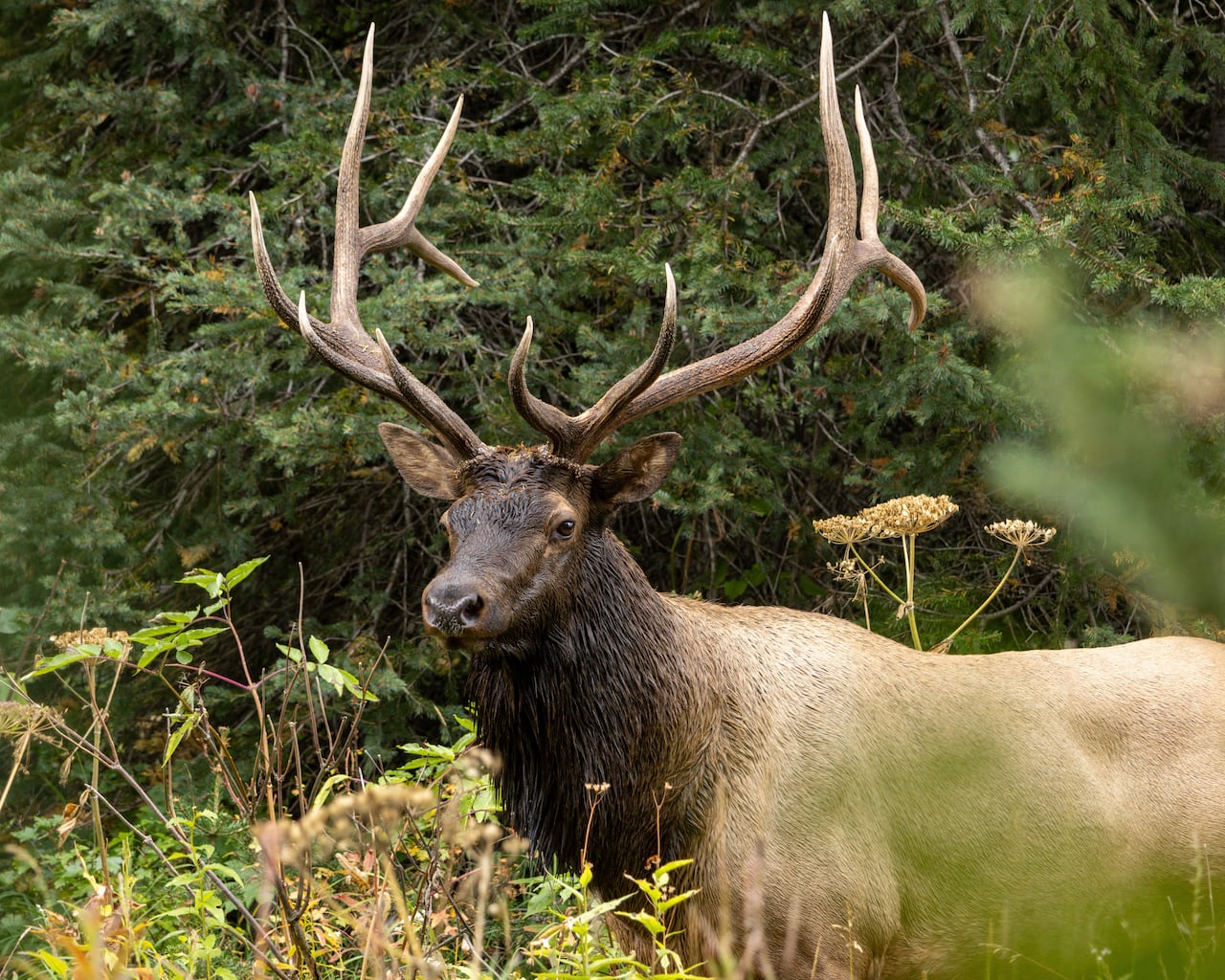
A bull elk in Yoho National Park, British Columbia. (Amir Said/CBC)
Jennifer Clarke, a professor of biology at the University of La Verne in California, published her research findings after examining elk populations in Colorado, Pennsylvania, and Wyoming.
“These three populations have been isolated for extended periods of time,” Clarke informed CBC’s Calgary Eyeopener.
“Much like human groups that remain disconnected over long durations, their communication evolves into unique forms. This is what has occurred with the elk.”

Why elk in Colorado, Wyoming, and possibly Alberta have their own regional dialects during mating season.
Bull elk bugle to signal their presence to other males. According to Clarke, this bugling is a strong display of aggression and serves as a means for the animals to declare their readiness to confront any rival.
Clarke notes that the bugles can also convey information about an elk’s age and size, with younger bulls often producing a “squeaky” sound compared to the more resonant calls of dominant mature males.
However, the precise reasons behind the varied regional dialects remain uncertain.
Clarke’s team initially believed that the differences were influenced by the elk populations’ diverse habitats across the states she investigated.
“Different sounds travel differently depending on the habitat,” she explained. “In densely vegetated areas, sounds may not carry as well unless certain factors are adjusted. In open habitats, different sounds can propagate more effectively.”

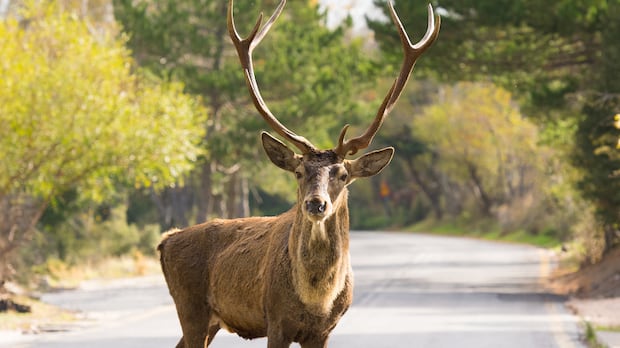
A bull elk crossing a road. In 2025, elk represented 138 out of the 7,449 roadkill incidents reported by the provincial government’s Alberta Wildlife Watch. (Amir Said/CBC)
The research team anticipated that the Pennsylvania population, residing in a thick deciduous forest, would utilize lower-pitched, longer tonal calls to enhance sound transmission. Conversely, populations in Wyoming and Colorado inhabit more open, arid coniferous forests and meadows.
With that perspective, they expected the elk from Wyoming and Colorado to share a greater similarity in sound than those from Pennsylvania.
However, their data did not support this theory.
The bugle call from the Pennsylvania population did not exhibit any greater disparity from its source population in Wyoming than the Wyoming calls did from those in Colorado. All three populations demonstrated significant uniqueness, indicating that habitat was not the driving factor behind the dialect variations.
“This leads us to consider genetics or learned behavior,” Clarke remarked. “These are separate areas of research.”
- Sperm whale groups found to have distinct culture, dialects
- Like real-life Dr. Dolittles, scientists are using AI to decode animal communication
She noted that research indicates genetics may play a role, but many questions remain unanswered.
<p"What we know is that the Pennsylvania population exhibits very low heterozygosity, which implies that these animals are more genetically similar to each other than those in Wyoming or Colorado," Clarke explained.
Due to this low genetic variation, the calls of Pennsylvania elk tend to sound quite alike.
In contrast, elk calls in Colorado and Wyoming vary more within their populations.
As for the acoustic characteristics of Canadian elk?
“I’m unable to provide an answer,” Clarke stated. “We initially thought habitat was a contributing factor, but it turns out that’s not the case. Thus, I can’t even speculate.”
Caution advised as rut season begins in Alberta
With the elk rut in full swing in the Canadian Rockies, experts are urging caution due to the aggressive and unpredictable behavior of bull elk during this period.
A comprehensive study conducted across more than two dozen Canadian national parks found that elk were implicated in nearly two-thirds of aggressive wildlife encounters.
A recent study is revealing factors contributing to aggressive wildlife encounters in Canada’s national parks. As reported by CBC’s Michelle McCann, the research indicates that conflicts seldom involve thrill-seekers or risky human behaviors, with a common animal posing the highest threat.
Nick de Ruyter, program director of the BioSphere Institute’s WildSmart initiative, mentions that elk are often spotted in fields, playgrounds, trails, and other public areas in Banff and Canmore.
Since these are the same locations where both residents and visitors frequently gather, the chance of close encounters with elk increases.
“During this season, male elk exhibit heightened aggression toward anything that comes too close,” de Ruyter noted. “This includes vehicles, cyclists, dogs—whether leashed or unleashed—and people, so it’s essential to provide them ample space.”
- ‘Extremely aggressive and protective’: Elk calving season underway in Alberta
- Banff’s elk population has declined since the 1990s, but that’s good for the national park’s ecosystem
He added that people sometimes provoke aggressive responses or even attacks by approaching elk too closely for photographs or selfies.
“The most advisable action for people is to maintain distance,” de Ruyter stated. “Typically, we suggest a distance of 30 meters or three school bus lengths for elk, but during the rut and calving season, I recommend increasing that to 100 meters or 10 school bus lengths because their reactions can be unpredictable.”
He emphasized the importance of being aware of surroundings on Bow Valley trails, keeping dogs on-leash, and carrying bear spray, which can also be effective against elk.

