
On Wednesday, severe flash floods in a border region between Nepal and Tibet resulted in the deaths of over 160 individuals and left hundreds—including 24 Canadians—unaccounted for as the waters surged through communities, disrupting travel in various areas.
Authorities in Nepal reported 162 fatalities, while China’s state broadcaster provided information indicating at least three deaths and more than 558 missing persons in Tibet’s Gyirong county as of early Thursday.
According to CCTV, among those missing, 260 were foreign nationals.
The Bhotekoshi River overflowed around 9 a.m. local time on Wednesday, obliterating numerous villages as well as roads and hydropower facilities, as reported by Nepali officials. Warnings were issued to residents in several districts of Nepal, advising them to avoid the banks of the Bhotekoshi, Trishuli, and Narayani rivers.
Sasmit Pokharel, a spokesperson for the Nepali government, stated, “We have requested assistance from both India and China for the rescue operations.”
According to Sunil Sharma, the acting director of public relations and publicity for the Nepal Tourism Board, 403 individuals, including 341 foreign nationals, are reported missing, with 24 of them being Canadian citizens. The Nepali ambassador to Canada later verified the details regarding the Canadians.
In a conversation with CBC News, Bharat Raj Paudyal mentioned that while he could not verify the specific circumstances surrounding the Canadians, the impacted area is well-known among hikers and is frequently traveled by pilgrims.
Prime Minister Mark Carney described the flash flood as “absolutely devastating.” In a statement on social media, he urged all Canadians in the region to register with the ROCA (Registration of Canadians Abroad) system promptly, affirming that Canada is prepared to provide assistance.
“Canadians are keeping those in distress in their thoughts, including those who have lost loved ones and those still awaiting news,” he added.
Global Affairs Canada acknowledged awareness of Canadians impacted by the floods, stating that while consular officials are present in the region, communication may be delayed due to power outages.
For emergency consular assistance in the region, Global Affairs Canada’s Emergency Watch and Response Centre can be contacted at +1 613-996-8885, by text at +1 613-686-3658, through WhatsApp at +1 613-909-8881, via Signal at +1-613-909-8087, or by email at sos@international.gc.ca.
Attempted Escape Before Landslide
Security footage from the Chinese side of the Nepal-Tibet border captured many individuals attempting to escape before a torrent of rock, mud, and water obliterated buildings and vehicles, causing people to vanish from sight.
Sharma reported that 133 of the missing individuals are from India and were on a pilgrimage to Mount Kailash in Tibet, a revered site for Hindus. Additionally, 47 individuals from the United States, 34 from Australia, and 33 from Britain are also unaccounted for.
-
Record rainfall in Japan leaves at least 8 dead, strands travellers
-
Thousands evacuated as Indonesia quake death toll rises to 53
Government representatives from South Korea and Malaysia separately indicated that several of their citizens are also unaccounted for.
Among the hundreds of locals trekking near Gosaikunda lake in Rasuwa, at least 62 Nepali citizens are missing as the local festival of Janai Purnima approaches, Sharma noted.

Rescue teams are racing against time to locate survivors following a massive flash flood at the Nepal-Tibet border that has claimed at least 150 lives and left hundreds missing, including 24 Canadians.
According to police spokesperson Abi Narayan Kafle, at least 28 law enforcement officials are among the missing.
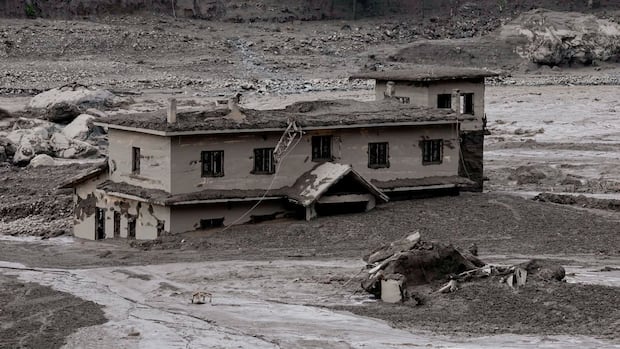
Nepal’s steep valleys serve as critical economic lifelines and travel routes, yet they become precarious during disasters. Images depicted the second floors of buildings in the severely impacted Nuwakot district coated in mud after the flood surged through. Debris was seen hanging from trees and power lines, while vehicles were buried and bewildered survivors were covered in mud.
Initial assessments from Nepali officials indicated that an earthquake in the vicinity may have led to the collapse of a glacier, triggering the floods. The U.S. Geological Survey later clarified that the tremor recorded at that time was due to the collapse of glacial rock and ice onto the valley floor.
The Trishuli River flows parallel to a highway north of the Kathmandu region, which is a route to one of Nepal’s most frequented trekking areas in the Langtang region.

Rescue operations are ongoing after an earthquake struck the mountainous Rasuwa district in Nepal. Officials report that around 400 tourists and travelers—some from India, the U.K., and Malaysia—are missing as crews attempt to access villages where homes are engulfed in mud.
China and India Ready to Assist
The United Nations and its partners are mobilizing resources and personnel in Nepal to assist communities affected by the disaster, stated UN Secretary General António Guterres.
Chinese President Xi Jinping has instructed officials to enhance efforts to locate those missing after the mudslide, according to the state news agency Xinhua. Chinese authorities are reportedly conducting extensive search and rescue operations in the Tibetan border region of Gyirong, as per CCTV.
Indian Prime Minister Narendra Modi has communicated with Nepali Prime Minister Balendra Shah to offer assistance.
Modi stated in a social media post, “India is ready to provide all possible types of humanitarian aid to Nepal. Our teams are coordinating closely on rescue and relief operations.”
In the Nuwakot district, one of the most severely affected areas, numerous multi-story buildings, trucks, and vans were buried under immense amounts of mud. Officials have cautioned residents in several districts of Nepal to avoid the banks of the Bhotekoshi, Trishuli, and Narayani rivers.
The areas affected by Wednesday’s incident experienced similar flash floods in August of the previous year, when a glacial lake in Tibet overflowed due to elevated temperatures in the mountainous region. During that event, nine deaths occurred, and critical infrastructure, including a bridge connecting Nepal and China, sustained damage.
Climate experts from the International Centre for Integrated Mountain Development in Kathmandu suggest that an avalanche from a glacier likely instigated the flash flood on Wednesday.
They reported that the Lhende Khola River, a tributary of the Bhotekoshi River, experienced the highest levels of flooding on Wednesday.
Saswata Sanyal, a disaster risk reduction specialist at the climate research organization, noted, “The Lhende Khola has flooded twice within 14 months, this time triggered by an ice rock avalanche from a glacier on the Nepal side that blocked the river and caused a sudden surge downstream.”
He added, “In a warming Himalaya, early warning systems are the first line of defense against adaptation.”
The Himalayan region, spanning Nepal and several neighboring countries including India, faces heightened vulnerability to heavy rainfall, floods, and landslides due to accelerated warming from climate change.

The aftermath of flash floods along the Trishuli River in Nepal’s Nuwakot district shows damaged homes and vehicles on Wednesday. (Niranjan Shrestha/The Associated Press)
Studies indicate that extreme weather phenomena, including heatwaves, intense rainfall, and glacier melting, have become increasingly common in the region.
Earlier this year, researchers from the Kathmandu research group determined that glaciers across the Hindu Kush Himalaya region are melting at an accelerating pace, with ice loss rates doubling since 2000, primarily attributable to rising global temperatures and climate change.

