

It is widely recognized that data centres powered by artificial intelligence consume a significant amount of electricity. However, the potential for these consumption levels to lead to increased energy expenses for residents in Alberta remains uncertain.
The Meta Data Centre, which is set to be established in Sturgeon County, Alberta, is anticipated to be one of the largest data centres in the province. According to a recent study by the Pembina Institute, a clean-energy think tank, household electricity bills could see an increase ranging from $270 to $460 annually once the centre commences operations.
David Pickup, the Pembina Institute’s director of energy, remarked, “The prospect of average bills rising by hundreds of dollars in the coming years serves as a stark reminder of the consequences these projects can impose.”
Data centres function as physical locations that contain the computing systems necessary for storing and distributing data for various technological applications that utilize AI.
As per the U.S. Department of Energy, data centres accounted for 4.4 percent of the electricity demand in the United States in 2023, a figure that may grow to as much as 12 percent by 2028.
In July, Meta Platforms Inc., the parent company of Facebook and Instagram, unveiled plans for a $13-billion data centre complex, which is expected to be operational within the next two to three years.
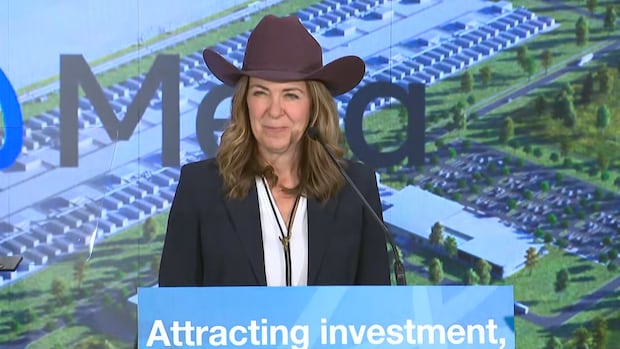
Tech giant Meta announced Wednesday its intention to construct a substantial AI data centre in central Alberta, marking the company’s first venture in Canada. Premier Danielle Smith, along with other government and Meta officials, revealed the details of the 1-gigawatt data centre, which has raised concerns regarding its energy needs.
The centre is set to connect with an adjacent power facility, the $4.6-billion Greenlight Electricity Centre, which is designed to generate 932 megawatts of power, with the potential to eventually double that output.
However, Meta has secured rights to link up with Alberta’s power grid before the Greenlight facility becomes operational, which is projected to happen in late 2030.
Both the provincial government and Meta assert that the Edmonton-area data centre will not lead to increased electricity prices for Albertans.
Nevertheless, the interval between the opening of the data centre and the construction of its power plant is a critical factor that could exert upward pressure on consumer electricity rates, as highlighted in the Pembina report and by experts consulted by CBC.
Supply-and-demand dynamics
Pickup indicated that the effect on electricity rates would be most pronounced in the years leading up to the Greenlight plant’s launch, tapering off as additional supply becomes available. The report estimates this timeframe to be from 2027 to 2031.
Kent Fellows, an economics associate professor at the University of Calgary, pointed out that a project of Meta’s scale could influence electricity prices if new generation capacity does not come online concurrently.
“A data centre consuming as much electricity as a large town or a small city is certainly going to impact the market if it doesn’t bring its own generation,” noted Fellows.
Without its own power plant, Meta’s operations could lead to higher wholesale electricity costs, Fellows added.
In Alberta, when wholesale electricity prices rise, retailers can modify their prices to maintain their costs and profit margins.
Fellows mentioned that the impact would diminish once Meta’s generation capacity becomes available.
“It’s important to keep in mind that this operates like any other market,” Fellows stated. “There are both supply and demand elements.” Werner Antweiler, a professor at the Sauder School of Business at the University of British Columbia, pointed out that Meta may require close to one gigawatt of electricity for its operations.
This amount constitutes about 10 percent of Alberta’s current generating capacity. For comparison, the city of Edmonton has a demand of around 1.4 gigawatts, according to the Alberta Electric System Operator.
“This will significantly reduce the supply cushion,” Antweiler remarked, referencing the surplus electricity available in the grid to prevent blackouts during sudden demand surges or plant failures.
“When you deplete the supply cushion in the grid, you are increasing prices because you are relying more heavily on these peak load plants,” he added.

Protesters gathered in Morinville, Alta., on Sunday to demonstrate against the proposed Meta data centre in Sturgeon County. The protest was organized by Ben Baril.
Antweiler acknowledged that the Pembina Institute’s projection of approximately a 15 percent rise in electricity costs is feasible. However, he noted considerable uncertainty regarding whether the increase would be 10 percent, 15 percent, or even 25 percent.
“These figures are not easily dismissible, as they align with anticipated demand trends,” he expressed.
A cumulative effect
The Alberta government is actively pursuing technology leaders like Meta and Google to establish operations in the province.
By late 2024, Technology and Innovation Minister Nate Glubish indicated that Alberta aims to have $100 billion invested in data centres within five years.
Although the Pembina report primarily focuses on the Meta data centre, it suggests there may be a cumulative effect.
“We expect similar, significant, and enduring impacts as more data centres are developed in Alberta,” it states.
-
Meta building its first Canadian data centre northeast of Edmonton
-
Alberta premier offers reassurances on massive Meta data centre
Pierre-Olivier Pineau, an energy policy expert and professor at HEC Montréal, stated that the potential consequences are not confined to Meta alone.
“An increase in load signifies a rise in demand, which places pressure on supply,” Pineau explained. “As demand escalates, prices increase, and that is how the market operates.”
Pickup noted that renewable energy, battery storage, and various technologies could help bridge that gap, along with mandates for data centres to decrease their electricity consumption during peak demand times.
In a video shared on social media last month, Premier Danielle Smith assured that if electricity supplies become constrained, priority will be given to Albertans’ homes, as the province’s grid emergency protocols prioritize households and essential services over industrial users.
“These projects can have considerable effects, but they do not have to,” Pickup stated.
“The policies in place are crucial in determining whether these projects will significantly affect consumers or serve as an asset to the grid and lower costs.”
Pickup added that alternative energy sources such as solar and wind could be utilized to alleviate some of the timing and cost challenges associated with launching a new gas plant.
By relying on gas power plants to supply electricity for the Meta data centre, he warned there could be added pressure on natural gas prices.
Alberta, Meta say no price increase
With the probability of additional data centres being established, the federal government recently introduced new principles for responsible data centre development, emphasizing that these centres should not transfer electricity costs to Canadians.
Additional principles include ensuring that data centres provide lasting local benefits, minimize environmental impacts, maintain transparency regarding local effects, and deliver strategic value to Canada.
So far, 42 organizations across Canada, including Meta, have endorsed this framework.
In a statement to CBC, a spokesperson for Meta asserted that the report relies on hypothetical scenarios and emphasized their commitment to funding new generation and grid infrastructure, which they claim will lower costs for Albertans.
“Meta will cover the full expenses associated with energy upgrades and the electricity consumed by our Sturgeon County data centre — these costs will not be passed on to Albertans — and we remain dedicated to matching 100 percent of the facility’s electricity consumption with clean and renewable energy,” the statement read.
A representative from Alberta’s minister of affordability and utilities stated to CBC that the Pembina Institute’s findings do not accurately reflect how Albertans incur electricity costs, arguing that increased demand from data centres can attract new generation and lower electricity prices.
“Our government has ensured that every Albertan has guaranteed access to a rate fixed for two years, with regulatory caps on increases,” the statement concluded.

