
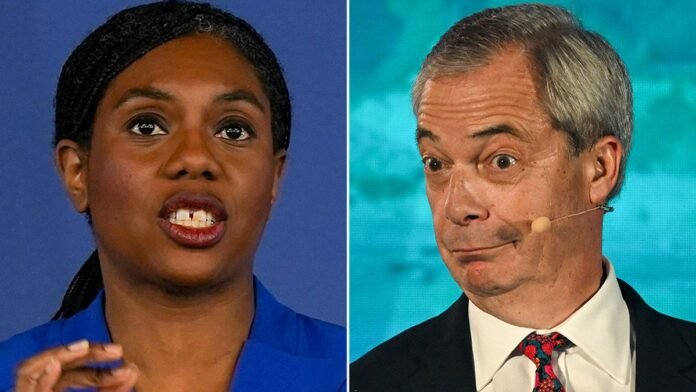

The possibility of the UK being embroiled in a war if Nigel Farage or Kemi Badenoch were in charge during the US and Israel’s strikes on Iran was highlighted by Keir Starmer. He criticized the flip-flopping of opposition leaders regarding the Middle East conflict.
Following the US-Israeli attacks, Kemi Badenoch criticized the Prime Minister for hesitating, while senior Reform members supported British involvement. However, both the Tories and Reform now seem to be backtracking on their initial positions.
The confusion within the Conservative Party was evident during a tense briefing after Prime Minister’s Questions, where Ms. Badenoch’s spokesperson repeatedly implied British involvement in the conflict. Meanwhile, Nigel Farage made a drastic U-turn, expressing reluctance to engage in another foreign war.
This shift has exposed both parties to criticism for indecisiveness and being perceived as “armchair generals.” It has also provided an opportunity for Labour to highlight Reform’s weaknesses in foreign policy and question Ms. Badenoch’s assertive stance.
A bipartisan letter, signed by over a dozen MPs with military backgrounds, was sent to Ms. Badenoch, demanding an apology for belittling the RAF’s efforts in the Middle East. This letter followed Keir Starmer’s strong condemnation of the Tory leader’s abrupt change in position on the conflict during PMQs.
The letter, spearheaded by former royal marine and Labour MP Alex Ballinger, criticized the Tory leader for implying that British forces were not sufficiently engaged in the region. The signatories included Labour MPs with military experience and eight Liberal Democrat MPs.
Amidst the recent events, Labour MPs and officials have seized on the readiness of both Reform and the Tories to commit Britain to a potential conflict. A source from the Ministry of Defence criticized their lack of credibility on national security and accused them of being inconsistent in their views on military intervention.
The response to the US-Israeli strikes on Iran has delineated a clear stance for Britain under PM Starmer, indicating a departure from aligning solely with US interests. The public sentiment has shifted against the US military action, with growing concerns about the economic repercussions of the conflict on households and businesses.
Nigel Farage’s controversial statements on various international matters have come under scrutiny, including his views on the Ukraine war. His alignment with Trump and Netanyahu’s aggressive stance towards Iran has raised questions about his judgment and consistency in foreign policy matters.
Labour is capitalizing on the vulnerabilities in Reform and the Tories’ foreign policy positions, emphasizing the distinction between Keir Starmer’s composed leadership and the opportunism displayed by the other parties. The decision to engage in war remains a critical issue, and the public’s trust in handling such matters is paramount.