
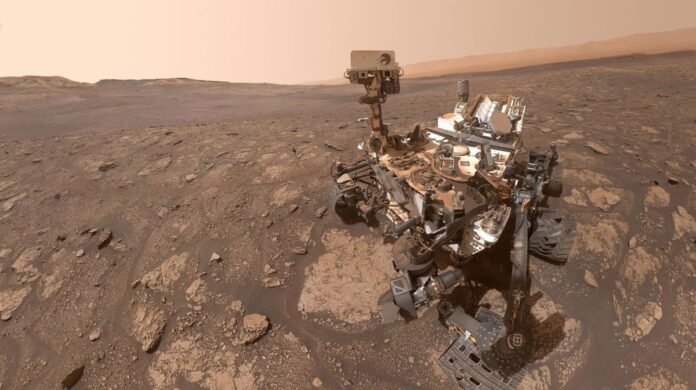

NASA’s Mars Curiosity rover has made a groundbreaking discovery of previously unseen organic compounds, possibly providing the strongest evidence yet for the existence of life on the Martian surface.
During a unique chemical experiment conducted on Mars, the nuclear-powered rover detected a diverse array of organic molecules, some of which are recognized as fundamental components for the formation of life on Earth. This revelation indicates that Mars has the capability to preserve molecules that could indicate ancient life forms.
Unfortunately, efforts to gather more crucial samples have been hindered by a funding shortfall within the US space agency, exacerbated by proposed cuts under the administration of Donald Trump. The cancellation of NASA’s Mars Sample Return (MSR) program in January has dealt a blow to scientists’ aspirations within the agency.
Leading the study, Professor Amy Williams, affiliated with the University of Florida and involved in Mars rover missions, emphasized the necessity of bringing rock samples back to Earth to definitively identify signs of past life. The termination of the MSR program due to budget constraints has left the future of planetary exploration uncertain.
The decision to eliminate the Mars sample return initiative has been met with disappointment and concern by experts in the field, including planetary scientist Victoria Hamilton from the Southwest Research Institute. The move not only jeopardizes the scientific goals of NASA but also raises questions about the country’s position in space exploration.
Despite the current limitations, the recent experiment conducted by Curiosity rover holds significant value in demonstrating the feasibility of searching for life-related evidence. The identification of over 20 different chemicals, including a nitrogen-bearing molecule similar to DNA precursors, and benzothiophene, a compound commonly found in meteorites, showcases the rover’s capabilities in analyzing Martian soil.
The experiment, carried out by the Sample Analysis at Mars (SAM) instrument suite, took place in the Glen Torridon region of Gale crater, known for its clay-rich environment indicating past water presence. These clay minerals are ideal for preserving organic compounds, making them a prime target for further exploration.
Published in the journal Nature Communications, the promising results of the experiment highlight the importance of ongoing missions in uncovering the mysteries of Mars. Future endeavors, such as the Rosalind Franklin mission and the Dragonfly expedition, are set to incorporate similar tests to search for organic compounds, building on the success of Curiosity’s findings.
Professor Williams stressed the significance of the discovery, emphasizing the potential for uncovering complex organic materials that could be indicative of past or present life on Mars. The study opens new possibilities for exploring the Martian environment and understanding its history.
The Curiosity rover’s mission, led by NASA’s Jet Propulsion Laboratory, has been instrumental in expanding our knowledge of Mars since its landing in Gale crater in 2012. The rover’s recent findings underscore the importance of continued exploration and research into the potential for life beyond Earth.