
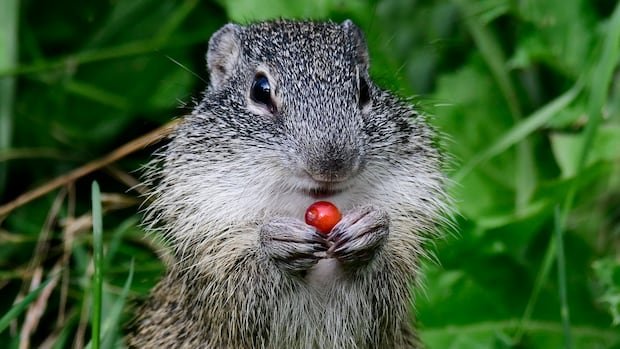
Researchers are urging Albertans to be on the lookout for a rare rodent known as the Franklin’s ground squirrel. This elusive creature is the focus of a wildlife biologist named Jess Haines who is leading a research project in partnership with Nature Alberta. The project’s inception stemmed from community naturalists noticing a decline in the squirrel’s population and realizing that no one was actively studying it.
The main objective of the project is to establish evidence supporting the decline in the Franklin’s ground squirrel population, which is currently categorized as “undetermined” by the Alberta government due to insufficient data. Haines aims to gather enough data through the project to prompt a reevaluation of the squirrel’s status to “at-risk.” Unlike Richardson’s ground squirrels, which thrive in human-altered landscapes like pastures and golf courses, Franklin’s ground squirrels depend solely on natural habitats with dense vegetation and forested areas.
The conversion of natural lands for agricultural and urban purposes has directly contributed to the decline of the once widespread Franklin’s ground squirrel population. While they used to be prevalent in central Alberta and beyond, their existence is now limited to a few remaining populations. Notable locations where Franklin’s ground squirrels can still be found include Wabamun Lake Provincial Park, Pigeon Lake, Dry Island Buffalo Jump Provincial Park, Rochon Sands Provincial Park, and Buffalo Lake.
Unlike other ground squirrels that live in large colonies, Franklin’s ground squirrels naturally exist in small numbers and low densities, making them vulnerable to local extinctions. To aid in their conservation efforts, Haines and her team, along with their students, conduct fieldwork to track and study these squirrels. The public is also encouraged to contribute by sharing historical and current observations of the squirrels through platforms like iNaturalist and the Nature Alberta website.
The ongoing project, which focuses on various aspects such as diet and habitat, does not have a set end date but evolves periodically to address specific concerns. The ultimate goal is to gather as much information as possible to ensure the protection and preservation of the Franklin’s ground squirrel species. Myrna Pearman from the Red Deer River Naturalists, who has developed a fondness for these squirrels, has joined the fieldwork to photograph them, highlighting the importance of raising awareness about their declining numbers.

