
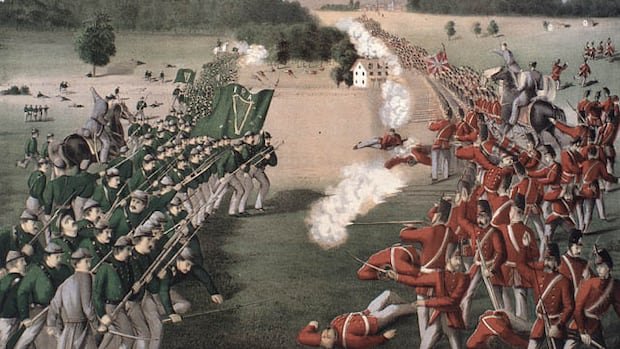

A lesser-known conflict that occurred in Canada just a year before the country’s confederation may not hold significant historical weight for most Canadians beyond the town of Fort Erie, Ontario. However, the Battle of Ridgeway, also known as Limestone Ridge, in 1866 marked the first instance of Canadian troops led by Canadian officers engaging in combat. This battle also served as the inspiration for Decoration Day, a precursor to Remembrance Day still observed in certain regions annually.
Despite its historical significance, the nine individuals who lost their lives in the battle are not commemorated in the Books of Remembrance, a compilation on Parliament Hill honoring soldiers who perished in service to Canada. A recent petition, to be presented in the House of Commons, aims to include these fallen soldiers, along with the numerous casualties following the battle, in the official list.
Conservative MP Fred Davies, who represents the Niagara South riding encompassing Fort Erie, where the battle transpired, emphasized the importance of recognizing those who made the ultimate sacrifice in defense of Canada. The conflict, which saw inexperienced Canadian volunteers confronting Fenian raiders, posed a formidable challenge, as the raiders, largely veterans of the American Civil War, sought to secure Irish independence from British rule through incursions into British North America.
Historian Peter Vronsky, author of “Ridgeway: The American Fenian Invasion And The 1866 Battle That Made Canada,” commended the rapid mobilization of Canadian forces despite their lack of adequate provisions and preparation for what he deemed Canada’s inaugural modern battle. The encounter culminated in a chaotic retreat by the Canadian troops following a Fenian bayonet charge, leading to the raiders withdrawing back to U.S. territory.
While the Battle of Ridgeway ended in a battlefield defeat for the Canadians, it symbolized a triumph in repelling the Fenian incursion. Davies emphasized that despite the tactical shortcomings, the valor displayed by those who defended Canada against foreign invasion warrants acknowledgment and commemoration.
A monument honoring the nine fallen soldiers from the Battle of Ridgeway was established in 2016, coinciding with the 150th anniversary of the conflict. Efforts by Fort Erie officials to have these soldiers recognized in the Books of Remembrance have so far been unsuccessful, prompting calls for their inclusion to honor their role in shaping Canada’s history.
Notably, the battle, occurring before the formal establishment of Canada, holds significance in the country’s narrative, with suggestions that it influenced the trajectory leading to Confederation. Several regiments involved in the 1866 battle, such as the Queen’s Own Rifles and the Royal Hamilton Light Infantry, continue to serve today, underscoring the enduring legacy of that pivotal moment in Canada’s military history.
Alexander Muir, known for composing “The Maple Leaf Forever,” participated in the Battle of Ridgeway, drawing inspiration for his patriotic anthem from the events of that conflict. Vronsky proposed that Muir’s choice of the maple leaf motif in the song may symbolize a shift towards Canadians fighting for their homeland and community identity, rather than merely as British subjects, signifying a turning point in the country’s military ethos.