
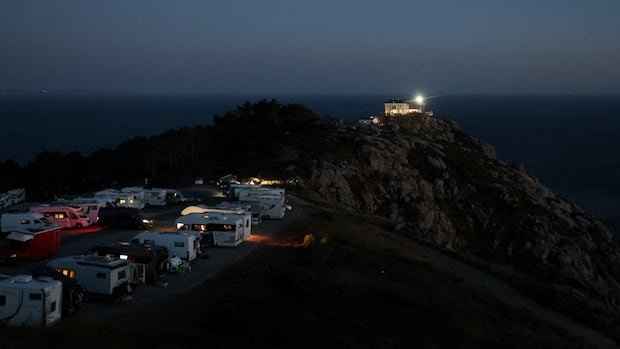

Hundreds of thousands of visitors have flocked to Spain with the aim of witnessing the solar eclipse occurring on Wednesday. However, the astronomical event coincides with high temperatures and an escalated risk of wildfires in Spain, prompting concerns for authorities looking to prevent long-lasting fire damage from the surge in astrotourism.
Virginia Barcones, the secretary general for civil protection and emergencies at Spain’s Interior Ministry, expressed the need for caution due to the challenging summer marked by numerous major forest fires in the country. Spain is currently battling a severe wildfire season with approximately 603,000 acres (2,440 square kilometers) of land scorched in around 400 fires so far this year, as reported by the European Forest Fire Information System.
In a bid to prevent additional fires, authorities are deploying 35,000 officers on Wednesday to monitor large outdoor gatherings and swiftly address any potential fire outbreaks, as mentioned by Barcones. Spain stands out as a prime location for viewing Wednesday’s solar eclipse, alongside northern Russia, eastern Greenland, and western Iceland.
It is anticipated that around 15 million people, mostly in Spain, will be within the eclipse’s path, with only those in the totality zone witnessing the complete coverage of the sun by the moon. As excitement mounts for this rare event, authorities are reminding viewers to use proper eclipse glasses for eye protection.
Special measures have been put in place by Spain’s Ministry of the Interior to manage the anticipated influx of crowds for the solar eclipse, resulting in a surge of searches for accommodations along the path of totality. The economic impact study conducted in July suggests that the eclipse could contribute over 347 million euros to Spain’s economy.
Despite the ongoing heat wave and wildfire concerns, travelers remain undeterred in their quest to witness the eclipse. The eclipse’s rarity and the unique experience it offers, such as the temperature drop and the visibility of stars and planets during the day, continue to attract enthusiasts from various parts of the world.
Looking ahead, the 2026 solar eclipse is just the beginning of a sequence of three solar eclipses that will be observable from Spain in the coming years. The upcoming celestial events are expected to further fuel astrotourism, with the 2027 eclipse’s path crossing southern Spain before extending into other countries, offering an enticing opportunity for travelers seeking extraordinary celestial experiences.