
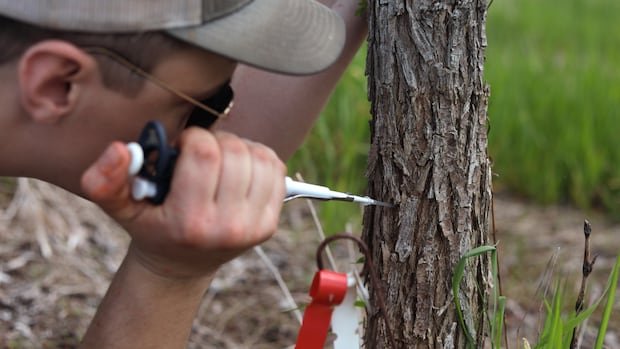
Scientists in Vermont have been intentionally infecting thousands of trees with Dutch elm disease this summer. This unconventional approach aims to test the resistance of a new generation of elms, bred from disease survivors, against the fungus transmitted by bark beetles that has been devastating elm populations in the U.S. and Canada for many years. The ultimate goal is to restore areas where majestic elms once thrived, adorning city streets and riverbanks.
Gus Goodwin, a senior conservation planner at The Nature Conservancy, expressed the profound impact of losing these trees over the years. Researchers are hopeful that the Vermont experiment, along with similar initiatives in Canada, will lead to the development of Dutch elm disease-resistant tree strains, offering a potential solution as the disease continues to pose a growing threat in different regions.
Historically, the “City of Stately Elms,” Fredericton, saw a significant decline in its elm tree population due to the disease outbreak in the 1960s and 70s, resulting in the loss of approximately 10,000 trees. The current challenge lies in preserving the remaining 1,000 mature elms, with efforts by experts like Anthony Taylor, a forest management professor at the University of New Brunswick, to protect these trees from the escalating threat of Dutch elm disease.
The disease, which rapidly spreads through the vascular system of infected elms, can lead to the tree’s demise within one to four years of contraction. To combat the spread, infected elms are promptly removed and disposed of. However, past practices of removing nearby healthy elms, known as “sanitization,” may have inadvertently weakened the elm population’s resilience to the disease by eliminating trees capable of withstanding it.
As Dutch elm disease continues to pose challenges for cities across Canada, including Edmonton and Saskatoon, proactive measures are crucial in mitigating its impact. The importance of preserving mature trees extends beyond aesthetics, as they play a vital role in providing shade, absorbing stormwater, and contributing to ecosystem resilience amid climate change challenges.
Efforts to combat Dutch elm disease involve long-term strategies such as breeding disease-resistant trees through initiatives like the Elm Recovery Project in Guelph. The process of crossbreeding and cloning resilient trees, although time-consuming, holds promise for creating a more resilient elm population that can coexist with the disease, akin to European elms. Through ongoing research and experimentation, scientists aim to develop sustainable solutions to safeguard elm trees for future generations.

