
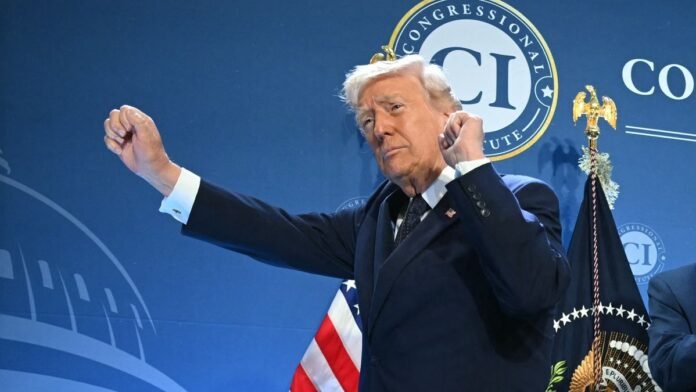

President Donald Trump has decided to extend the ceasefire in Iran and the blockade of the Strait of Hormuz indefinitely, just before the deadline was due to expire. Trump cited the breakdown of negotiations, attributing it to the internal divisions within the Iranian government. Despite this, he expressed readiness to engage in discussions if a unified proposal is presented.
In a peculiar turn of events, Trump is scheduled to read a passage from the Bible on live television, urging Americans to repent. This follows his recent social media post portraying himself as Jesus Christ. The reading, which took place at the Oval Office’s Resolute Desk, was part of a larger initiative organized by “Christians Engaged.” Trump’s participation in this event contrasts with his previous inability to recall a favorite Bible verse.
Amidst the ongoing developments, peace talks with Iran faced uncertainty as both sides hinted at a potential continuation of hostilities in the absence of an agreement. While Trump avoided signaling military escalation, he warned of potential consequences if no deal is reached. Notably, Iran’s chief negotiator hinted at undisclosed strategies yet to be revealed.
Additionally, Trump’s administration decided against enforcing mandatory flu vaccinations for the U.S. Armed Forces, following the controversy over COVID-19 vaccine mandates. This decision, announced by Pete Hegseth, was framed as a move to uphold medical autonomy and religious freedom within the military ranks. The exemption from flu vaccinations comes amid public health recommendations advocating for widespread influenza immunization.
Trump’s past military deferments resurfaced in the spotlight as he claimed he could have swiftly resolved the Vietnam War had he been in charge. His deferments, including one citing “bone spurs,” have faced scrutiny, with doubts raised about the validity of his medical condition at the time. In a separate incident, Press Secretary Karoline Leavitt sparked online mockery after a post suggesting Trump sought treatment for mental illness, which was later clarified to focus on advancing mental health care access.
Overall, Trump’s recent decisions and statements reflect a mix of diplomatic maneuvers, religious engagements, and healthcare policy shifts, shaping the ongoing narrative surrounding his administration.