
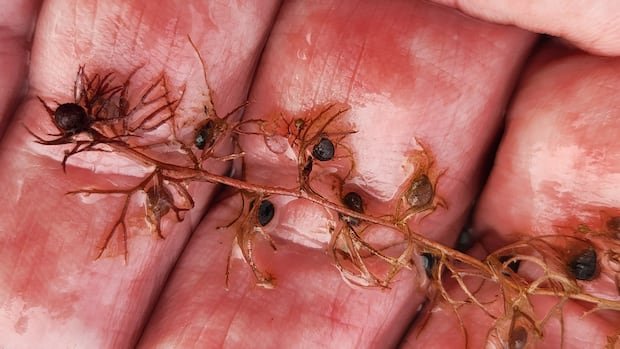

Plant enthusiast Klaus Koehler made a remarkable discovery at Sylvia Grinnell Territorial Park near Iqaluit in July. While exploring, he encountered a rare plant species in the Arctic, raising concerns about the potential impact of invasive species in Northern regions due to climate change.
Koehler came across a plant known as bladderwort when he reached into a pond. Although it may appear inconspicuous to the untrained eye, Koehler recognized its distinct features.
This carnivorous plant is adorned with small black bladders containing partially digested flies. Typically found in more temperate climates, bladderwort rarely ventures into the tundra. Previously, the only documented sighting of this plant in the area was in 2012 near Kimmirut, about 120 kilometers southwest of Iqaluit, as reported in the scientific journal Phytokeys.
During three Arctic expeditions, a research team identified over 30 new plant species in the Arctic archipelago. Koehler believes that the discovery of bladderwort could signal a changing climate, facilitating the migration of plants not traditionally found in the Arctic due to warming temperatures.
The shift in climate conditions, characterized by milder summers and reduced winters, is fostering a more favorable environment for non-native plant species to thrive in the Arctic. This transformation is expected to alter the local ecosystem significantly, with invasive and native species extending their ranges northward.
Paul Sokoloff, a senior research assistant at Ottawa’s Museum of Nature, shares Koehler’s concerns. He emphasizes the potential threat posed by invasive species entering Arctic ecosystems through various means, such as birds, cargo ships, and human activities. Sokoloff highlights the detrimental impact invasive species can have on native flora and fauna, citing the example of phragmites, a Eurasian grass species that has wreaked havoc on Ontario’s ecosystem for years.
While Koehler’s discovery may not have immediate adverse effects, the proliferation of invasive species in the Arctic could jeopardize the native biodiversity. Researchers have identified thousands of plant species with the capability to invade Arctic habitats, posing a significant challenge to preserving the region’s unique ecosystem.
To further study the expansion of bladderwort in Iqaluit, Koehler plans to collect a sample for analysis by the Museum of Nature. This initiative aims to enhance scientific understanding of the plant’s northward migration and its implications for the Arctic environment.