
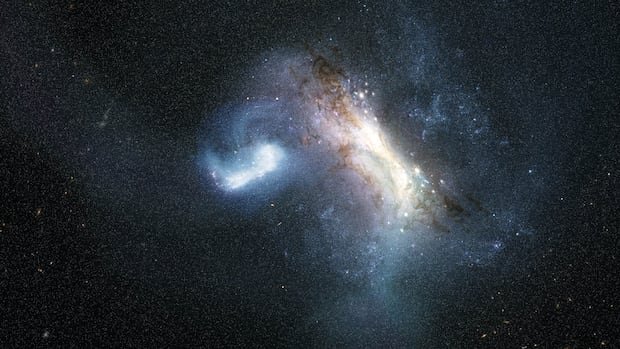

A recent study has shed light on the intricate evolutionary journey of the Milky Way galaxy, unveiling a significant event that occurred early in its history. Researchers examining star clusters near the galaxy’s core have uncovered evidence of a merger with a smaller galaxy approximately 11.8 billion years ago, during the universe’s infancy. This marks the earliest-known galactic fusion for the Milky Way, demonstrating its growth through both internal star formation and the absorption of smaller galaxies within its gravitational influence.
The assimilated galaxy was classified as a dwarf galaxy, distinct from larger galactic structures like the Milky Way. Estimates suggest that it contained stars with a mass equivalent to 500 million solar masses at the time of the merger, roughly a quarter of the Milky Way’s size back then. By analyzing stellar clusters within the Milky Way’s innermost 20,000 light-years using the Hubble and Gaia telescopes, researchers gauged their age, chemical composition, and trajectory, providing insights into the galactic integration process.
This merger, occurring approximately two billion years after the Big Bang, introduced stars from the dwarf galaxy, termed Low-energy-Kraken-Heracles (LKH), into the Milky Way. Astrophysicist Davide Massari, the lead author of the study published in Nature Astronomy, emphasized the significance of this discovery as the first merger event experienced by the Milky Way during its early stages.
The study suggests that the merger infused the Milky Way with a substantial influx of stars, interstellar gas, and dark matter, fueling subsequent star formation processes. While the merger was relatively peaceful in terms of stellar interactions, the collision of gases from LKH and the Milky Way likely triggered intense star formation activities.
Massari highlighted the presence of stars from LKH still embedded within the Milky Way’s inner regions, particularly within stellar clusters, albeit challenging to identify due to interstellar dust. Notably, the Milky Way has been involved in two other significant galactic mergers, including one with Gaia-Sausage-Enceladus and ongoing interactions with the Sagittarius dwarf galaxy over the past six billion years.
According to Massari, each merger event has influenced the formation of our solar system and Earth, underscoring the importance of reconstructing the Milky Way’s history to address fundamental questions about our origins.