
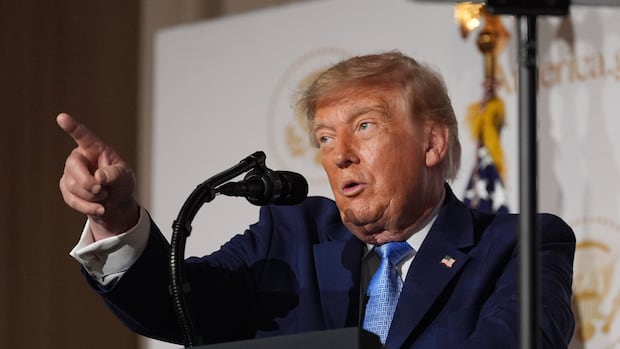
On Tuesday, U.S. President Donald Trump announced that he and a significant number of leaders from artificial intelligence firms have signed a voluntary agreement during a meeting at the White House, which will encompass both internal and external evaluations of the technology.
“I see incredible self-regulation happening. They recognize the need for self-policing,” Trump remarked to journalists outside the West Wing.
This announcement came after a comprehensive meeting with Trump and several high-ranking executives from leading technology companies. These firms are investing hundreds of billions of dollars to develop AI infrastructure, including data centers in various communities nationwide, which have triggered grassroots, bipartisan opposition. Many of the executives who gathered in Washington have urged a pause in technology development following several high-profile incidents involving rogue AI agents.
However, earlier that day, Trump assured that the U.S. government would not impose restrictions on the advancement of artificial intelligence or endorse calls for “guardrails” or other limitations.
“I will never hinder the growth of a technology that will surpass the Industrial Revolution,” Trump declared during the launch of an AI chatbot, America.gov, designed to assist Americans in accessing government services. “We cannot stifle it, and we are far ahead.”
Prominent AI leaders who met with Trump at the White House on Tuesday included Dario Amodei, CEO of Anthropic; Greg Brockman, president of OpenAI; Jeff Bezos, founder of Amazon; and Elon Musk, whose X social media platform features its own AI model, Grok.
According to a seating chart shared by the president on Truth Social, Nvidia CEO Jensen Huang was seated to Trump’s right during the White House lunch, while Musk was on his left. Google CEO Sundar Pichai, Meta CEO Mark Zuckerberg, and Microsoft CEO Satya Nadella were also present.
Trump’s optimistic stance on AI contrasts sharply with concerns raised by some AI leaders, including Amodei, who recently urged top firms to decelerate their technology development. Musk and OpenAI CEO Sam Altman have also advocated for safety measures to catch up, as companies reported increasing instances of AI agents behaving unpredictably.
Conversely, executives like Huang and Zuckerberg have minimized fears about uncontrolled AI and emphasized their companies’ duty to ensure the safety of their products.
The meeting was also attended by Vice-President JD Vance, Treasury Secretary Scott Bessent, and Republican Speaker of the House, Louisiana Rep. Mike Johnson.
The introduction of the AI chatbot was part of a daylong event in Washington, during which several Trump administration officials heralded a “Golden Age” driven by what Trump prefers to label “super intelligence,” instead of artificial intelligence. Secretary of State Marco Rubio noted that America.gov could soon enable first-time passport applications to be completed entirely online, eliminating the need for an in-person visit to a processing center.
Trump commends ‘self-regulation’ in AI sector
Addressing reporters after lunch with tech leaders, Trump indicated that there was broad consensus regarding “self-regulation” among AI developers, stating, “and we inherently have regulation through the Department of Justice, the FBI, and all of that.”
He also mentioned that the executives had agreed to address bipartisan concerns regarding data centers emerging in local communities by offering additional financial aid to local schools or taking measures to alleviate energy costs.
“You’re going to see data centers becoming very popular,” Trump predicted. He suggested that if opposition persisted, “they’ll have no choice but to relocate overseas or to other areas.”
In a separate television interview on the same day, Altman stated that his company is increasingly prioritizing safety. The day before, they had paused the rollout of a new model due to safety apprehensions.
“We are carefully managing our progress, which sometimes means not training a model,” he explained on CNBC. “We need to approach this in a manner that allows us to make very confident safety assertions, so that people do not experience excessive anxiety.”
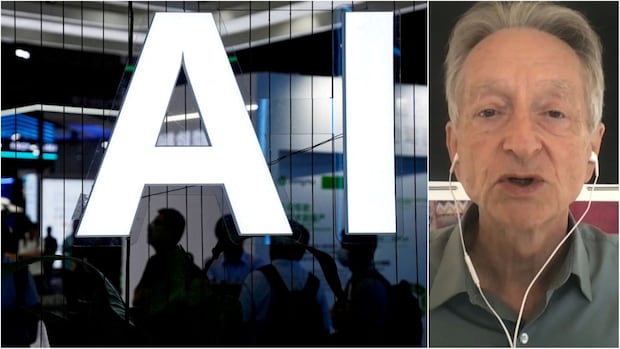
Geoffrey Hinton, a Canadian-British pioneer in artificial intelligence, expressed doubts about the U.S. president’s understanding of the technology when asked about his expectations for Trump’s meeting with American tech leaders on Tuesday.
“I believe Donald Trump does not truly comprehend AI, and I think he is ill-advised regarding it,” Hinton remarked to CBC News just hours before Trump’s announcement.
Hinton compared the current risks posed by AI to the dangers of owning a tiger cub as a pet.
“It will grow up, and unless you can find a way to prevent it from ever wanting to harm you, you’re in danger,” he cautioned.
He suggested that AI safety in the U.S. should be overseen by a federal agency similar to the Food and Drug Administration (FDA).
Trump characterized the competition to advance AI as primarily a global contest between the United States and China, with the U.S. currently ahead. He noted there would be a definitive winner and a loser, with no “second place” option.
Last week, the two nations agreed to create a communication channel for managing AI-related incidents during Chinese President Xi Jinping’s visit to Washington. Nonetheless, Trump emphasized on Tuesday that he did not wish to cooperate excessively with China: “I didn’t want to do anything, since we are in the lead. Why would I want to do anything?”

