
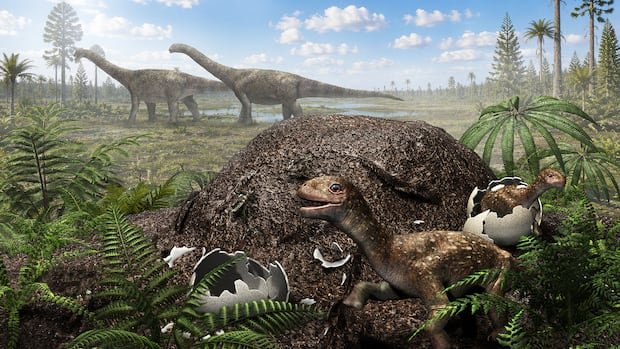
A discovery of fossil eggshells believed to belong to some of the largest dinosaurs ever found has been made in a surprisingly cool climate distant from the equator. Despite their immense size, these titanosaur dinosaurs could not rely on incubating their volleyball-sized eggs by sitting on them due to their size. A recent study, led by University of Tsukuba paleontologist Kohei Tanaka and published in Royal Society Open Science, delves into the microscopic analysis of titanosaurs’ eggshells to unravel their incubation methods.
The research indicates that titanosaurs likely employed a similar incubation technique to modern crocodiles, burying their eggs in warm piles of decomposing vegetation to maintain the necessary warmth for hatching. These titanosaurs, massive plant-eating dinosaurs weighing up to 75 tonnes, roamed ancient ecosystems, including the Chorrillo Formation in southern Argentina, where fragments of titanosaur eggshells were unearthed.
The Chorrillo Formation, dating back to the Late Cretaceous period, offered a glimpse into a vibrant coastal plain inhabited by various dinosaurs, such as the titanosaur Nullotitan glaciaris and the smaller herbivore Isasicursor santacrucensis, alongside other creatures like crocodiles, snakes, and mammals. The study sheds light on the ingenious nesting strategies of these colossal dinosaurs, showcasing their adaptability to diverse environments.
While smaller dinosaurs may have brooded their eggs like birds, the titanosaurs had to resort to alternative methods to ensure successful incubation without crushing their eggs. By analyzing the porous nature of the titanosaurs’ eggshells from the Chorrillo Formation, researchers concluded that these eggs were likely buried, allowing for optimal oxygen exchange for embryonic development.
The findings highlight the remarkable adaptability of dinosaurs, even the largest among them, in navigating the challenges of reproduction and nesting in varied environmental conditions. The study underscores the need for further exploration into the nesting behaviors of titanosaurs across different regions and time periods to unveil the full extent of their evolutionary strategies.

