
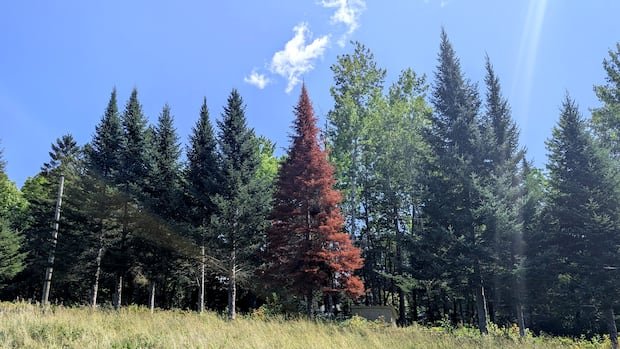

Balsam fir trees in New Brunswick are exhibiting red discoloration and mortality post a significant drought last summer, sparking concerns about the fate of the provincial tree. Professor Anthony Taylor, a forestry researcher at the University of New Brunswick, has been contacted by woodlot owners who have witnessed the damage firsthand. The once vibrant evergreen trees, commonly used as Christmas trees, are gradually turning red, drying out, and perishing.
According to Taylor, the observed trend aligns with previous instances following hot and arid summers. He emphasized that warm and dry conditions, like the recent drought, have a detrimental effect on the growth capacity of balsam fir trees. Taylor, who has been studying the impact of climate change on New Brunswick’s forests for an extended period, highlighted previous balsam fir die-offs post unusually hot and dry summers in 1986 and 2018.
The trees halt the photosynthesis process prematurely in response to drought conditions, impeding their growth potential. This disruption results in a depletion of energy reserves necessary for basic metabolic functions and defense compound production. Consequently, stressed trees are more susceptible to pest infestations or diseases, leading to increased mortality rates.
Balsam firs have shallow root systems, making it challenging for them to access water during dry periods. Peter McKeil, a woodlot owner, noticed the onset of damage to balsam firs on his property in June. The trees are progressively turning red from the lower branches upwards, with new red spots emerging daily, indicating an ongoing die-off. McKeil estimated a loss of approximately 100 trees thus far and has adjusted his harvesting practices to salvage remaining firs before further losses occur.
McKeil expressed concerns about the future of the species, particularly in southern New Brunswick, attributing the decline to worsening climate change effects. He anticipates that balsam firs may need to adapt or migrate northwards as a survival strategy. Taylor emphasized the significance of the visible impact on the trees as a reflection of climate change consequences, urging for urgent climate action to mitigate further environmental damage.
Taylor’s research serves as a tangible indicator of the urgent need to transition away from fossil fuels and adopt sustainable forest management practices to combat climate change effectively. The red hue on the balsam fir trees serves as a warning signal, emphasizing the need for immediate action to safeguard the ecosystem’s future.