
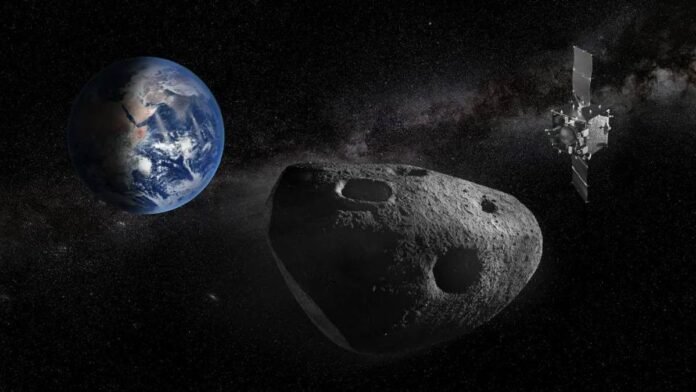

NASA has officially announced the precise timing of an uncommon, massive asteroid’s upcoming flyby near Earth, making it the closest encounter with a celestial object of its magnitude in human records. The asteroid, known as Apophis and named after the ancient Egyptian God of evil and destruction, will pass remarkably close to our planet in the foreseeable future. The National Aeronautics and Space Administration (NASA) confirmed this week that the asteroid is set to safely pass by Earth in 2029, creating a visible spectacle in the night sky on a date considered by some as extremely unlucky: Friday the 13th of April, 2029.
Apophis will approach within 20,000 miles of Earth’s surface, closer than the orbits of many satellites and nearly 12 times closer than the average distance from Earth to the moon. Initially, when this Near-Earth asteroid was discovered in 2004, there were concerns of a potential impact in 2029, 2036, or 2068. Subsequent observations using optical telescopes and ground-based radar have provided a better understanding of Apophis’ orbit over the years.
Based on the accumulated data, NASA now asserts that Apophis poses no threat of colliding with Earth for at least a century. Initially, there was a 2.7% probability of a catastrophic impact, but recent radar observations in 2021 dispelled any such danger. Nonetheless, the close proximity of such a large asteroid presents a rare opportunity for global scientists to study the colossal space rock up close. NASA highlighted the significance of the 2029 flyby by stating, “This will be the closest approach by something this large currently known. Apophis will be visible to the naked eye for several hours, and Earth tides will probably change its spin state.” Preliminary assessments of Apophis’ shape suggest it resembles a peanut and measures approximately 1,230 feet in length, slightly taller than the iconic Eiffel Tower at 1,083 feet.
At present, NASA monitors around 2,000 asteroids, comets, and other space objects that may approach Earth closely. While most asteroids do not enter the Earth’s atmosphere, there is a rare possibility of significant impacts from these massive space rocks affecting weather systems. Not since the catastrophic asteroid strike that led to the extinction of dinosaurs 66 million years ago has Earth encountered a space object of apocalyptic proportions.