
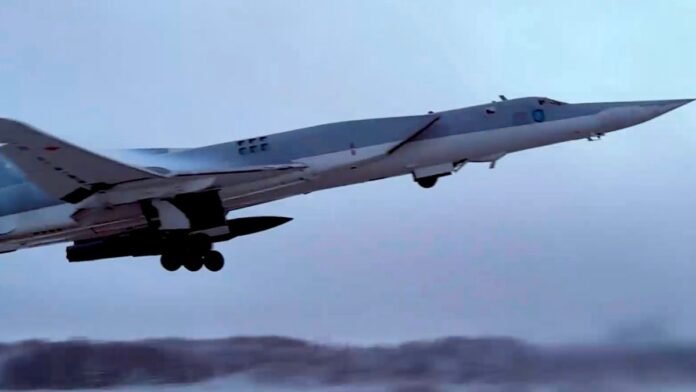

NATO fighter jets were deployed to monitor Russian strategic bombers capable of carrying nuclear weapons on a mission across the Baltic Sea amid escalating tensions in the area. The Russian air force, led by Vladimir Putin, conducted the operation within international airspace, accompanied by Russian Su-35 fighter jets. The Russian defense ministry’s TV channel Zvezda confirmed that NATO aircraft had followed the bombers along certain parts of their route. The channel stated that the flights strictly adhered to international airspace regulations and even captured footage of an F-35, a NATO aircraft, in close proximity.
The show of force by the Kremlin coincided with accusations from Moscow that Finland, Estonia, Latvia, and Lithuania had allowed Ukrainian drones to traverse their airspace to target crucial Russian oil facilities. These allegations were promptly denied by Western nations and Kyiv.
Despite the denials, high-ranking Russian officials, including Foreign Minister Sergei Lavrov, issued stern warnings to the West about possible retaliation by Moscow. Russian Security Council Secretary Sergei Shoigu emphasized Russia’s “inherent right” to self-defense, hinting at the potential for military actions against Finland, Estonia, Latvia, or Lithuania.
Concerns are mounting that Russian President Putin may test NATO’s collective defense commitment under Article 5 by carrying out a strategic, limited incursion in the Baltic region, potentially targeting an island. Sweden’s Chief of Defence, Michael Claesson, cautioned that Russia might be planning to seize one of several Western-owned islands in the Baltic Sea as a direct challenge to NATO. Among the islands deemed vulnerable are Sweden’s Gotland, Denmark’s Bornholm, and Estonia’s Hiiumaa and Saaremaa.
Shoigu alleged that there had been an increase in Ukrainian drone attacks on Russia via Finland and the Baltic states, causing harm to civilians and significant damage to infrastructure. He suggested that either the Western air defenses were ineffective, or the countries in question were complicit in aiding aggression against Russia.
He stressed that, in accordance with international law and the UN Charter’s Article 51 on states’ right to self-defense, Russia could act if faced with an armed assault. Nikolai Patrushev, a close ally of Putin and former FSB security service chief, accused NATO members of complicity in the attacks on Russian oil ports.
MP Andrei Kolesnik, known for his hardline stance, characterized Shoigu’s statements as a final warning supported by Putin, cautioning the Baltic states against acting with impunity towards Russia.